Showing posts with label Alaska. Show all posts

Tuesday, June 28, 2011

Contentment: Fishing Days


When my longtime friend and fishing buddy Brian invited me to go wet a line during my recent visit to Juneau, I expected to write about it. Of all the activities that engaged me during a lifetime in Alaska, a day of fishing is one that bears closest resemblance to the kind of day I work toward having more and more of now in Yucatán.

Why? Fresh salmon is soul food to me, but the experience is more about having a day than getting a fish. In fact, Brian and I have a way of talking about going out fishing. We don't say we're going to go out and catch a bunch of fish. We just casually say that we ought to go and "have a look around."

Years ago I heard various Alaska Native elders talk about going out hunting. In some cultures tradition says that the hunter needs to be humble, because the animals sense human arrogance and will not give themselves to someone who is not respectful, not "right" in heart and mind. The hunter who says something like, "I'm going out to have a look around," or, "I'll just take a walk down river," might come back with meat for his family. Someone who offends nature -- "let's kill us some fish" -- will come back empty handed.

So we have a routine: I bring all the food, Brian gasses up his boat, and we head out for the day and start "looking around," with carefully-prepared bait trailing in the depths behind us, of course. 
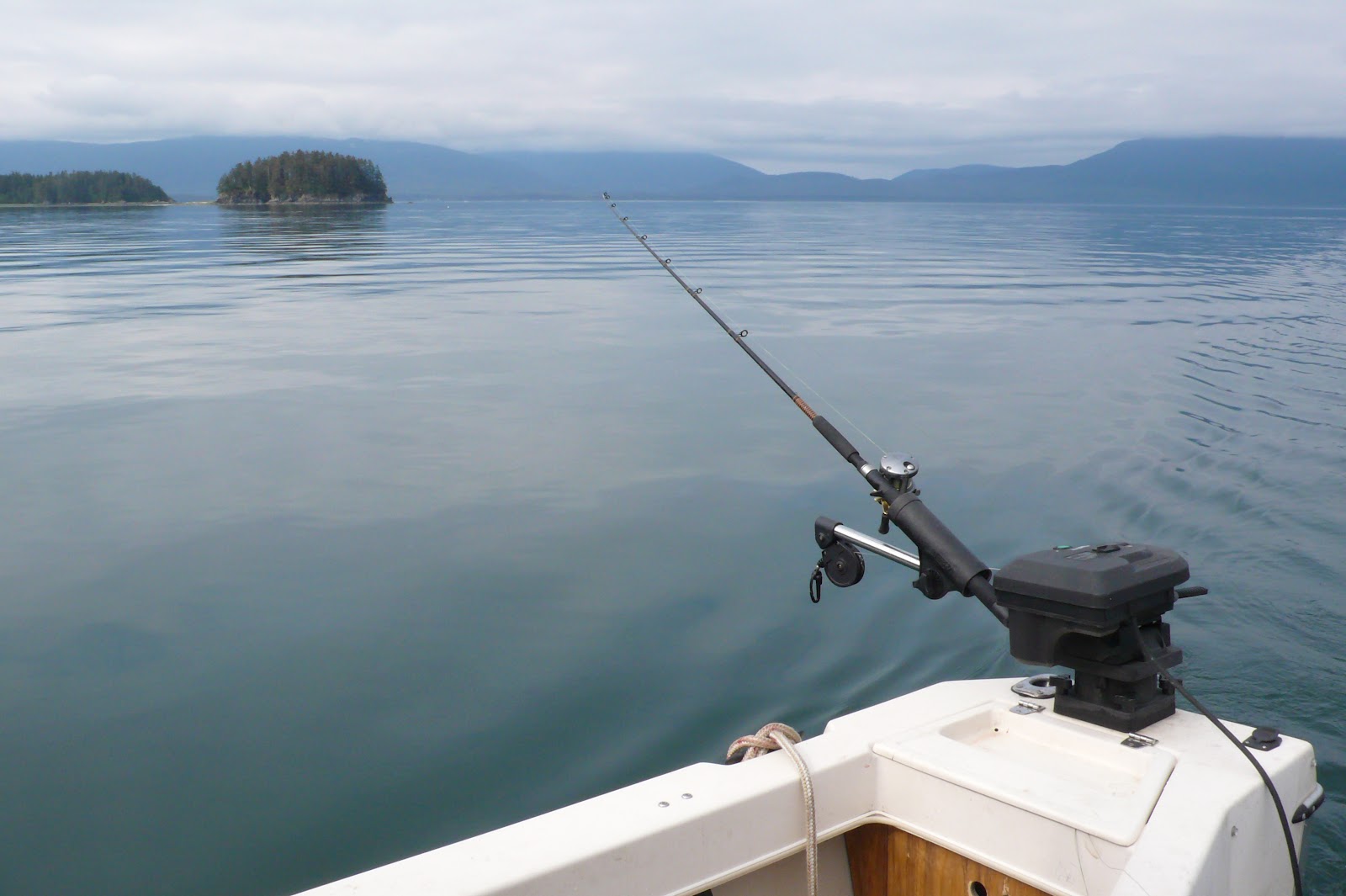

And there is always plenty to look at: varieties of birds, fish, innumerable eagles, seals, sea lions, and often lots of whales. Interesting things float by. It is a day in which moment succeeds moment. 

The wind shifts, and we're in a chilly mist. I am sipping coffee as the tide ebbs. The sky changes and the day evolves. Clouds thicken and briefly a shower drenches us; the sun finds an opening and highlights the snow-capped Chilkat mountains and a distant glacier.

As the overcast dissipates, I warm up and begin to shed layers: raincoat, halibut jacket, wool shirt. I trail my hand in the water, and taste it as it drips from my fingers.

The peace and calm of observing nature and weather is punctuated occasionally by the quiver of a fishing pole, and sometimes that leads to the capture of a nice salmon or halibut. But more often than not, bait is snatched away and something down there has got a free meal on us, or we carefully release an undersized or unwanted fish. 

Or nothing at all happens.

Although not always a lot of it, there's talk. After about twenty-five years of fishing together we've shared a lot of experiences, so at times we retell old fishing stories: long hauls in his small skiff before Brian got the bigger boat; getting caught in bad weather; monster fish that got away; the time we hooked halibut and several species of salmon all in one day. We laugh about the time I got seasick on the brand-new boat and my trip to the ER with a hook in my thumb. The conversations range through many other subjects. Talk flows easily.

There's also the music, always jazz or rock oldies. And food. I habitually bring fat prepared sandwiches from the deli counter of a local store, apples, other snacks, drinks and Snickers bars. It's become a tradition. I only eat them when fishing, but for fishing you've gotta have Snickers. 

Breaking out the food used to be a good luck charm. It seemed that for years, no sooner would we have all the lunch goodies spread out than we would hook something. Inevitably some of the food would end up dropped and trampled on the deck, a casualty of the action. We've continued to try the "get out the sandwiches" ploy when fish aren't biting, even though it hasn't worked in years. Fishermen, like baseball players, are superstitious. Speaking of superstitions, there's my fishing hat, but that's another story.


We don't always connect with fish, but as things went on this recent day, we were watching some "rock jockeys," beach fishermen on North Douglas Island, when suddenly one of the poles started vibrating. It wasn't long before we reeled in a magnificent gift from Mother Nature in the form of a medium-sized King. As I looked into its eye and felt its fat but sleek body I felt truly blessed to be who and where I was and in the company of a good friend. 

I could not have wished then to be any other place nor to be doing anything else on earth. What more could one possibly ask from a day than that?

Every fishing day is different, but each "look around" is also a nostalgic repetition of something that could not be improved upon and that I wouldn't change in any way. Catching fish is not the main point. For a whole list of other reasons, every fishing day is a perfect day.


Thursday, March 18, 2010

Anthropology: Urban Vestiges


I really enjoy looking at architecture and the bits and pieces of cities that inform us about the past. It is easy to overlook sometimes that although evidence of the past may change form or context, it is still with us. Matter and space do not disappear; it's the arrangement that evolves.

I recall peering out a seventh-floor window of the Mendenhall Apartments in downtown Juneau, Alaska, where I lived, on and off, for many years. One day in the 90's I noticed, high on a building nearby, on a side now hidden from street level by more recent construction, a peeling, antique-style black painted sign for the San Francisco Bakery. The bakery was still there under another name when I was young, but the San Francisco logo was probably out of use before I was born. From the style of the lettering I guessed the sign was likely from the pre-World War One era. I did a little checking. The business opened in 1914. Bingo! What I noticed was possibly an original sign, long ignored and unnoticed, that continued nevertheless publicizing an enterprise, now closed for decades, that was selling bread when my grandparents were children. Although the ovens are now next door and the old bakery space is a dining room, the bakery tradition is continued in the same place after almost 100 years, now operated by the Silverbow Inn.

I also remember a multi-colored, billboard-sized 1937 Chevrolet ad painted on the side of an old brick building along Alaskan Way in downtown Seattle, which was visible from my earliest memory until the wall was altered or demolished maybe 15 years ago. I miss that sign. It was a little piece of history, forgotten and unappreciated, that spoke to me from the past. It is these kinds of experiences that have fed my interest in the detective work of discovering details about the past from the vestiges that survive, often unappreciated or uninterpreted, today.


Mèrida, where I have lived for the past few years abounds in these kinds of clues. And since it is a very old place, having been a thriving Mayan city before the arrival of the Spanish in the 1500's, the vestiges of the past are varied and fascinating. I started thinking about all this some time ago when I began passing over the above advertising message, fired on tiles set in the sidewalk. It's placed like a welcome mat in front of the doorway to an abandoned building a few blocks down the street from my house.

The corner building, whose unadorned architecture and location indicate that it's quite possibly a true colonial-era structure, apparently once was a pharmacy that sold, "Roberina, 5 centavos, cures headache, toothache, rheumatism, colds." I wonder if Roberina was a patent medicine, or perhaps as a friend suggested, something made in Mèrida of local herbs. That is very possible. There is a vast treasury of traditional medicines used by the Yucatecan people, even today.

On my way to take the pictures above, I passed by this plaque on a building that stands at the corner of Calle 57 and Calle 70, not far from home and almost at Parque Santiago.

These plaques are to be found at intersections all over the historical center of Mèrida. In days when only clergy and the wealthier classes were literate, the rest of the people needed a way to navigate and find things around the city. Many of the important intersections were named after landmarks, objects or animals, and if necessary signs or sculptures picturing the identifying names were installed at the crossings. I live nearest the corner of "Los Cuatro Vientos," The Four Winds. Also nearby is the corner of "Dos Soldados," Two Soldiers. The Robelina ad and abandoned pharmacy is at "El Cardenal," The Cardinal. That plaque is visible in the photo of the building (above).

El Coliseo, The Colisseum, was the original bull ring of Mèrida, situated at this intersection which still bears its name. I figured out where the structure was located after seeing this sign. I noticed that, in a neighborhood that consists of very old buildings, there are two blocks, near this intersection, of much more modern architecture. When El Coliseo was torn down and replaced by a new structure in a different location several decades ago, houses and businesses were built in its place. So, although the original structure no longer stands (what a shame), its shadow remains still, for those who are willing to see it. A large and beautiful painting of El Coliseo, by the Yucatecan painter Mario Trejo Castro, hangs in the cafe La Flor de Santiago, on Calle 70 just around the corner from the plaque and a stone's throw from the site of the old bull ring. La Flor is a venerable establishment dating from the 1920's. I suspect in the old days that many of the conversations echoing off the cafe's walls were uttered by customers stopping in for refreshment either before or after going to a corrida at El Coliseo.

There are many more, often more ancient vestiges apparent to a person walking observantly around this city, and I plan to write more about them. However, this week I am going to end with evidence of a modern
corporation that did business in Mèrida, and was practically a household word in the United States through the middle of the last century. The above logo, incorporated into metalwork above the unused side door of a well-known downtown building, now a hotel, provides a clue. What was the name of the business, and what did they sell? To the person who first posts the correct answer below in the comments section of this blog, a free lunch for two at El Principe Tutul Xiu, one of the finer Yucatecan-food restaurants in Mèrida. Or, if the winner prefers and provides the transportation, I'll buy at the original location of this same restaurant which serves delicious poc chuc and other fine traditional dishes in the pueblo of Manì, Yucatàn, a place also rich in fascinating clues to the past.


Thursday, December 10, 2009

Transitions


I just got back from a visit to Alaska. It's always a great pleasure to return, catch up with family and good friends, revisit favorite places and gaze at the very mountains that exist unchanged from my earliest memories.
It's a long trip that I have made dozens of times and it has become routine, but I have learned to enjoy the familiar transitions along the way. The journey typically begins as I lug bags past my hammock and under the arches of the patio to board an early morning taxi that delivers me to one of Mèrida's bus stations, and a morning bus, le lujo class (movies with headphones, drinks, recliner seats, nice bathrooms), for the four-hour trip from Mèrida to Cancun. It is easy to sleep on the ride; the scenery along the modern Mèrida-Cancun toll road is mostly the uniform green of the flat, forested Yucatecan plains. There isn't much variety in the view. I always plan a couple of extra hours for this trip, to allow for weather or bus problems, and normally arrive in Cancun with a little time on my hands. It has become my habit to trail my luggage out of the Cancun bus terminal, and eat a hearty lunch of enchiladas or a burger, followed by leisurely cups of coffee over the newspaper, at the Sanborn's restaurant across the street. Sanborn's is a large chain and a Mexican institution; I remember in the early 90's arriving in Guadalajara fresh from Barrow, and going to eat in the first restaurant I saw: a Sanborn's. Since then, Sanborn's restaurants have been a reliable and comfortable place to go when I visit larger cities in Mexico.

After lunch, I cross back to the bus station and grab an airport bus, and upon arrival at the airport board a shuttle or take the ten-minute walk over to the new Terminal 3. The first order of business is to go to the Immigration counter for an exit visa. Next, to Alaska Airlines to check in, and afterward to pass through security into the boarding area. The new terminal was designed so that it is impossible to get to the boarding gates without walking through the duty free shops, which in addition to tequila sell exactly the same types of expensive perfumes, designer watches and other "luxury" products seen in duty-free shops the world over. Here, sunburned tourists can squeeze some final moments of enjoyment from their vacation by maxing out their credit cards, if they haven't done so already. Personally, I walk quickly though Duty Free. Once through the gauntlet, there's plenty of time to get a latte and relax.
It's a more-than-five-hour flight from Cancun to Seattle, which these days is my port of entry into the United States. Alaska Airlines has added additional flights and this is a good one; in the past we normally passed though customs and immigration in the noisy chaos of always-under-construction LAX before a circuitous walk to a different terminal and encounters with hollering, cocky TSA employees, in order to board the connecting flight. The direct Seattle flight saves time and line-standing energy, and at Seatac the formalities are calm, friendly and efficient. My itineraries usually include a long stopover in Seattle, arriving late in the evening and boarding a northbound flight early in the morning. Often I pass the seven or so hours on a favorite couch in a little nook of concourse "C" at the airport. It is secure and quiet after midnight and the only people you see are the cleaning crew. It is easy to sleep if you don't mind being watched by security cameras as you do so. I don't mind because I can really sleep; there isn't much worry that someone will pick my pockets or snatch my bag. And, mornings are calm there because my bags are checked through and I haven't passed outside of airport security. I simply wash up and change shirts in the spacious restroom, eat breakfast, buy a paper and coffee and wait to board my plane.
Occasionally in Seattle, I work out a longer stopover and go into the city. This recent trip was one of those. A friend since my Anchorage days in the early '80's, Paul picked me up at the terminal, and I spent a pleasant 22 hours in Seattle, hanging out on the houseboat he lives in on Lake Union, eating out, and catching up. My family lived in Seattle for several years when I was small; it's always interesting to look around and discover that, despite all of the growth and changes, many of the familiar landmarks of my childhood are still there.

Flying to Alaska from Seattle is always the same: there are friends and familiar faces on the plane. I often get to talking with old friends, former neighbors, coworkers or ex-students in the boarding area. Sometimes I see people I haven't seen in years, or decades. It's always interesting, and time spent waiting to get on the plane passes quickly.

Arriving in Sitka or Juneau, I am always struck first by the cool moisture of the clean-scented air, something that it's easy to take for granted when you live in Southeast Alaska all the time, but when I have been away, it is the first thing I notice. The exact nature of this aroma of home is something a little beyond words that revives distant memories and awakens feelings. When I walk off the plane, I know exactly where I am.

Speaking of home, sometimes when I pass through immigration when returning to the States, the officer who stamps my passport will say, "welcome home," as he or she returns it. Since I was born and lived most of my life in Alaska, it will always be home, however in more recent years I also feel very much en casa, at home, in Mexico. After my visit up north, I arrived back in Mèrida late in the evening a couple of nights ago, and in the morning when I woke up there was nothing to eat in the house. I decided to walk the three blocks to the market at Parque Santiago, where there are some small restaurant stalls, planning to order an omelet. When I arrived, the hot, tangy aroma of choco lomo, a breakfast broth with chunks of beef and served with onions, radish, cilantro, sour orange wedges and tortillas -- a very traditional Yucatecan breakfast -- reached my nostrils. I used to eat this breakfast when I first bought the Mèrida house, before I fixed it up and put in a working kitchen. Eating choco lomo is among my first warm memories of living in Yucatàn, and the unique smell brings back the sentiments and memories of those first exciting days here.

I said "buenos dias" to the couple I sat down next to and ordered the choco lomo, with a Coke. Very Yucatecan. When it came, I put the garnishes in my broth, broke up the meat and liver chunks and began eating the meat rolled up in tortillas. It really tastes great contrasted with the cold, fizzy cola, sucked through a straw from the green glass bottle. A young man who makes his living selling sweets in the park whipped the tray off his head to display his wares and asked me if I wanted a meringue. An older man played an electronic keyboard and sang traditional songs for tips just down the corridor. It's interesting, but I realized while eating that breakfast that Yucatàn no longer feels foreign to me. I seem to be "going home" when traveling in either direction.


Wednesday, November 4, 2009

Fall Colors: Not what you think


This morning I was reading a family member's blog in which she published a photo showing the snowline edging down the mountain, the cold mist and weak sunlight yesterday in my hometown of Juneau, Alaska. After signing off I walked out of my house, into the cool but comfortable morning, and was immediately reminded why I like living
where I do this time of year. When my friends and relatives up north are wearing sweaters and parkas and already exercising their snow shovels, in Yucatàn I am still enjoying fall colors.

NOT the "fall colors" they might expect. As I went out, I immediately noticed the first purple blossom of the
thumbergia that grows up one wall of the house. Buds are forming all over this huge plant, whose climbing branches can reach 45 feet/ 14 meters in length, and soon it will be full of cascades of hanging flowers. Seeing it, I went back inside and grabbed my camera. This is what I saw around the back patio this morning.


Way out back I saw that there are still some flowers on the neighbor's white plumeria, here known as Flor de Mayo, which hangs over my garden. True to its name, this tree usually begins flowering during the month of May. This one just keeps on going, although by this time of year the blooms are getting scarce. Near it, the sensuous flaming-orange blossom of the granada, or pomegranate, above, is the first one this year that has not shriveled and fallen off before reaching maturity.


Bougainvillea, bugambilia in Spanish, blooms just about all year round. The peach variety, above, is in a small planter and has never grown much. The hot pink plant was just a little stick when I put it in about a year and a half ago. Now it measures over 12 feet/4 meters high, and is growing like crazy. It is hard to prune due to its sharp thorns.

Yellow irises continue to produce fresh blooms for months. The one seen here unfolded shortly after I took this image. Pink and yellow mandevilla, below, will grow together but are quite different. The pink is extremely delicate; the yellow very hardy and grows at a dramatic rate.


I thought astromelia was a smaller bush. This one has grown to be way above my head.

I do not know what this wildflower is. I suppose the seed was dropped by a bird. Several have sprouted in the garden. One reached more than 3 feet/1 meter across and had hundreds of blossoms.


Two fruit-producing plants: creamy white papaya flowers with yellow centers; strong pink nopal cactus flowers perched atop their tunas, or fruits, which make good eating when mature if you are very careful about their needle-fine spines. Hummingbirds love the nopal flowers.


This is known locally as Copa de oro. This plant reproduced like crazy. I started with a couple tiny pieces of root, and now have dozens of them. Hummingbirds visit these, too. They actually perch on the flower and come to rest while feeding.
Does anyone know what this is? A friend gave me some seeds months ago, and it has produced hundreds of flowers. The blooms last one day, and usually drop off by evening. The good thing is, there are always more.

I only know about these plants what friends and neighbors tell me. If anyone reading this has more information or better names, please leave a comment or email.

Tuesday, October 27, 2009

Beginnings: Alaska, Mexico, Lila...


When I moved south I considered starting a blog as a way to keep friends and family up to date on what I was doing. Now, more than four years later, I finally got around to it. A lot has happened in that time that probably will never make it into the blog: restoring my old house; travels around the country; exploring pueblos and stumbling upon ruins that seem to be completely lost in time; new experiences in teaching; tasty culinary adventures; learning about new plants, animals and environments; making many new friends and losing some; adjusting to a new culture; several dozen north-south round trips; just to mention a few.

The great thing about living where I do is that each day really is a new adventure. One of the reasons it took me this long to get started on a blog is that there is so much going on around me I don't spend much time at home on the computer. As long as I have the energy I will choose being "out among 'em," as Mom always says," over the alternative of hanging around the house.


OK, about Lila Downs. There are several reasons I have included pictures of her in this post. First and simplest, I just got back from Lila's latest concert in Oaxaca, downloaded my pictures from the trip, and it is on my mind. Second, she has been my favorite artist in current music for quite some time, and is someone from modest beginnings who has been internationally recognized but remains admirably close to her people and roots. And, for several reasons, in my mind she is permanently linked to my two "homes," Alaska and Mexico.

The same month in 2003 that I closed on the purchase of my house, in Merida, Yucatan, a dear friend invited me to a concert that Lila Downs was giving where I lived in Juneau, Alaska. Before that experience I had never heard of her. After it, I was hooked, bought all of her CD's, and began listening to Lila Downs and paying attention to what she was doing. During the next couple of years, my interest in getting out of the states grew in direct proportion to my utter disgust with the Bush administration and my keen interest in being in my new Yucatecan home as much as possible. The music became more inspirational and personal as I made decisions and began working toward making the idea of moving a reality. Within two years, my slightly-decrepit, entirely pink, old Yucatecan house in the historic barrio of Santiago, which I had planned to use for vacations and in some distant future as a retirement residence became, falling plaster, bats, leaking ceilings, dust, and all, my full-time home. Lila Downs' music accompanied me, with its beautiful spirit and as bridge between two cultures, as I initiated and then followed through on one of the biggest transitions in my life.

Lila's performance earlier this month in Tlaxiaco, Oaxaca, where she grew up, was the third of her Oaxaca concerts I have attended. The fact that the concert was presented to a hometown crowd made it especially meaningful. There were several welcoming events and ceremonies in the pueblo, including the unveiling of a plaque at her childhood home and a parade through the center of the pueblo, attended by a large number of press, fans, family and friends.


A very pleasant experience I had was being introduced to Lila's godmother Victoria at my hotel, and being invited by her to go down to the concert together. We had a long and interesting conversation, and through Victoria I met a lot of people. I was introduced as the person who had come all the way from Merida for the concert, and who first saw Lila perform in Alaska; as a result I answered a lot of questions. I was admitted backstage, and due to the identity of the person I was walking around arm-in-arm with, was announced by the security personnel as I entered as "Lila's Godfather." I didn't laugh until later that evening. Lila was gracious and although apparently suffering from a sore throat and tired, spent some time chatting with me. She and her husband, Paul Cohen, remember fondly their visit to Juneau, the warmth of the people, and especially a trip to the glacier.

The evening of the concert was by far the highlight, but the entire visit was fascinating. In Oaxaca it is easy to enjoy great food, beautiful scenery, the fresh, pine-scented air, and glimpse the unique cultures and adaptations they have made to this environment. In Tlaxiaco it is normal to hear the sounds of various dialects indigenous to the area as you walk around the pueblo or explore the market. And, as an

Alaskan transplanted to Mexico, I experienced pleasant moments of homesickness as I hiked neighborhoods and along a road out of town and passed many older structures, which look remarkably like their northern counterparts. The only real clue to the different environment in this photo is the red-tile roof. I have noted similar log construction in Queretaro and in Michoacan. Undoubtedly it also exists in other forested parts of the country.

Another reason I feel "a gusto" in Mexico is that it reminds me in some ways of the pre-pipeline and rural Alaska of my childhood (and of the older generations in the villages, still), when people really did know and look out for each other, spent time together doing things instead of talking on the cellphone, hovering around the cable-TV box or computer, appreciated how they were connected to their environment, and did a lot for themselves. Both Alaska and Yucatan also have a history of being culturally different, isolated penninsulas, far from the mainstream and centers of governemnt of their respective countries.

From what I have seen, there are challenges faced in both places that are very similar. As a teacher who has worked for many years in villages and with indigenous populations in both north and south of the border, I see the same issues, among which are: how to preserve culture and at the same time fit into a modern, rapidly changing world; how language- and cultural- minority children adapt to a school system that is based upon another language and a westernized urban culture that does not understand them; the terrible cycles of poverty and social disintegration that often accompany loss and cultural dislocation.

On the positive side, Mexico as well as Alaska retains a rich variety of traditional cultural knowledge, expressed in its enduring ways of life and survival. Here in Yucatan, folks still put out chairs and sit in front of their houses at night, rocking, talking and greeting neighbors in a way that seems hardly to exist anymore in the U.S. The last I recall of anything similar in the states was sitting on my grandmother's front porch on South Main St. in Wichita, Kansas during visits on hot summer evenings. When was that? Hint: while the grownups talked, I identified makes of cars by the style of their outrageous tailfins, and from that porch, amazed, we watched the Soviet satellite Sputnik track across the sky.


Here, people still say "good morning" to strangers, and manners are important. Here, adolescents are not embarrassed to be seen and to be affectionate with their parents in public. In Merida, it is still possible to live in an urban neighborhood where you can go to the market, cafes and restaurants, parks, the movies, galleries, theater and concerts, buy hardware or a mattress, get the car, shoes, a chair or a bike repaired, have your teeth cleaned, buy new glasses or visit a medical specialist, do all manner of errands or shopping, within a one-to-fifteen minutes' walk from the front door. Here, doctors still make house calls and a visit doesn't break the bank. In Yucatan, the abundant fresh fruits and vegetables are reasonably priced. In Mexico, safe, comfortable and economical long-distance bus transportation and safe, clean, and affordable hotels and restaurants still exist. In my neighborhood, a french-style baguette from the bakery down the street with wood-fired ovens costs about a quarter, and a beer in a local family-style cantina (no drunks or crude language allowed) served with abundant appetizers, maybe a dollar. Here, craftsmanship and individualized customer service and attention is still available, and home-delivery of products and services at no extra charge is common. Where I live, despite what the sensationalist, histrionic, news-tainment media would have you think, life is safe, secure, friendly and tranquil.

I am initiating this blog with the principal idea of keeping far-away family and friends more up to date. However, to old friends and new: if these topics interest you, welcome. The blog is still under construction. I'll add a few features as things get rolling.


Tlaxiaco, Oaxaca, October 2009
Powered By Blogger