This piece about Padre Luis Quintal Medina was posted originally under the title, "An Unorthodox Priest." I haven't seen much of Padre Luis in the last year or two, so when I learned that he'd had open-heart surgery, I went to visit him in Hunucmá, his birthplace, where he is recovering and being cared for by family.
My friend Victor and I met Padre Luis several years ago in Maní, and stayed a few times at his place there, where we became "amigos del corazón," according to the Padre," friends of the heart." When we recently planned a visit to Maní and in contacting him found he was not there, he offered the use of his house ("es su casa") in his absence. We accepted the hospitality, but visiting Maní and staying at his place last week was not the same without the Padre around.
After seeing him yesterday, I can report that Padre Luis is doing well, and in a month or so hopes to be back home in Maní. Meanwhile, with him in my thoughts, I repost this portrait of the Padre from April, 2010.
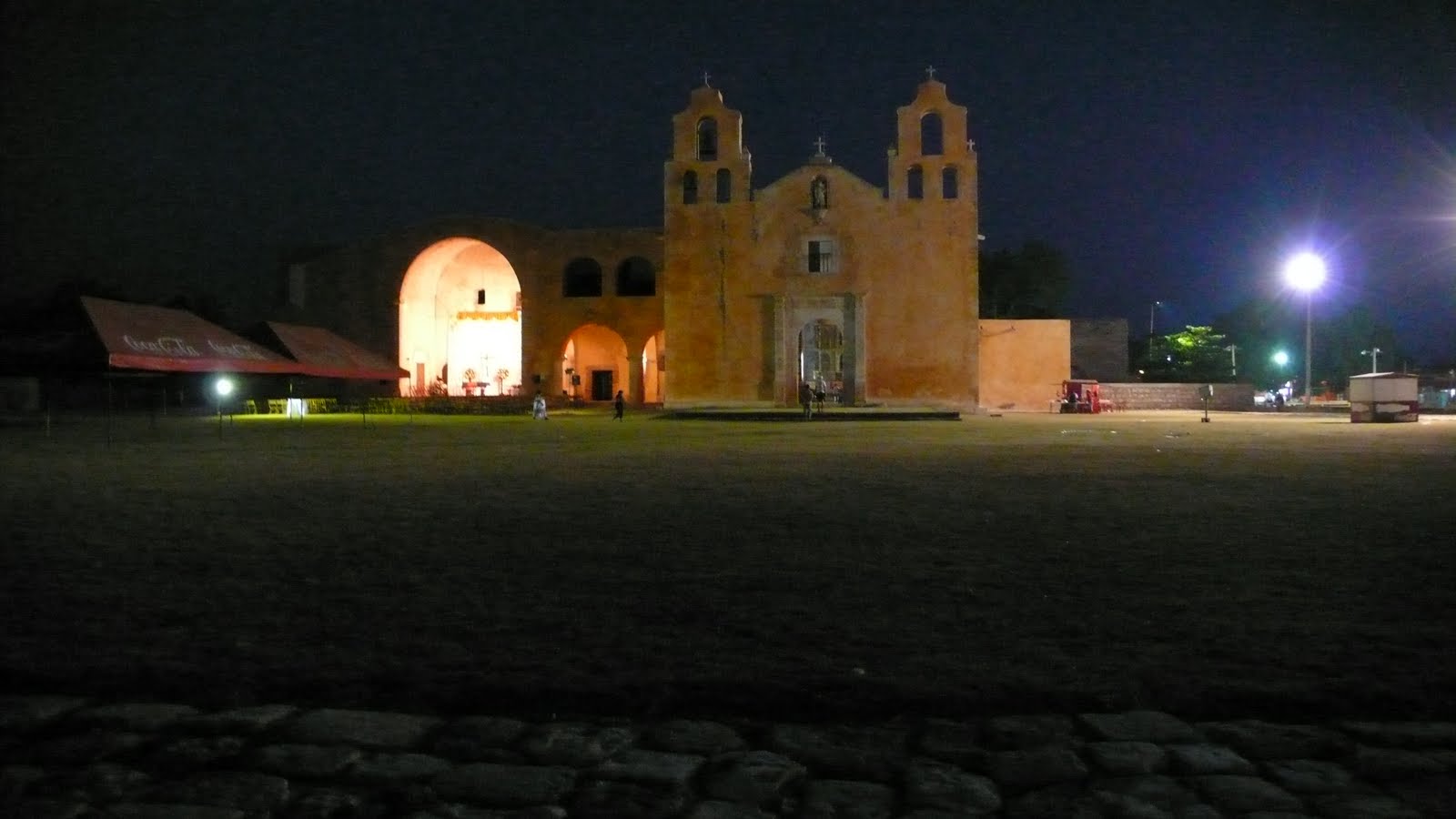
In Maní, as in most old pueblos in the Yucatán, the architecture consists mainly of a mixture of centuries-old colonial buildings and modern, utilitarian and often less attractive structures of cement block. Occasionally one will come across a much more ancient style of construction, the beautiful, elegantly simple oval Maya house, but these structures are fragile (they burn easily, and tend to blow away in hurricanes, for instance) and are only occasionally seen now because most people who can afford it want something more secure, modern and lasting.

 However in Maní, located in the southern part of Yucatán state, if a carload of tourists were to become disoriented on their way to see the church and mistakenly turn down a certain rough side road, they might stumble upon an unexpectedly picturesque and bucolic scene. First they'd spy pointed roofs of palm fronds topping oval houses made of rough poles and plastered with red mud, scattered along the rocky cerros and shaded by native trees like pich, cedro and chacà roja that dot the grassy landscape. The foliage, seed, flowers and fruit feed and shelter dozens of species of birds; parrots, cardinals, vultures, grackles, doves, woodpeckers, chachalacas, hummingbirds and a variety of multi-colored songbirds (to name a very few) that fly freely above and rummage in the brush. Wild orchids, some of which are species in danger of extinction, droop from the crooks of the trees.
This scene isn't, and yet it is, a dream.
The visitors have not inadvertently eaten a strange, hallucinogenic herb in their salad, or passed through a time warp back to an idealized pre-Colombian Mayan Eden. This place is real and exists in the year 2010. The lost tourists are not dreaming. They have found a dream.

The dream belongs to Father Luis Quintal Medina, known by everyone simply as Padre Luis, a Roman Catholic priest of Mayan descent who grew up in Hunucmá, near Mérida, and has made his home in the Maní area for many years. This compound is the dream's living incarnation.
One incongruity the tourists might have missed upon first glimpsing this idyllic vista is a steel column supporting large solar panels, which looms up above the rustic skyline. It's important because it is emblematic of this particular project.
 A few more details about the Padre. Right now he does not have a parish, and the reasons are several. Technically, he is on sick leave, having had some heart problems. However, as he tells it, he also has had some disagreements with the church ("a church of the rich"), and is one of a small group of non-conformist priests that is at odds with the hierarchy in certain respects. That's about all he will say regarding the matter. But, from a little research and talking with others I learned that Padre Luis founded and led for years the well-known Escuela de Agricultura Ecològica U Yits Ka'an, in Maní, which teaches, tuition-free, environmentally appropriate, "green" agricultural techniques, until he was summarily relieved of the directorship and moved to another
parish awhile back.
It seems that the Padre, a conservationist, is a bit liberal in some other areas. He is known for incorporating traditional Mayan rites into the Catholic mass. The words "liberation theology" pop up in the conversation. The heart of the matter is that Padre Luis is controversial, a priest without a church, maybe because he was too popular or too powerful. I am not positive, but this is the idea you get in talking with people who know him. At any rate, what really matters is what he is doing now. Although not being paid by the church, he still assists with things like masses and weddings when asked. But he spends most of his time these days planning and building, planting and growing.
It seems that the Padre, a conservationist, is a bit liberal in some other areas. He is known for incorporating traditional Mayan rites into the Catholic mass. The words "liberation theology" pop up in the conversation. The heart of the matter is that Padre Luis is controversial, a priest without a church, maybe because he was too popular or too powerful. I am not positive, but this is the idea you get in talking with people who know him. At any rate, what really matters is what he is doing now. Although not being paid by the church, he still assists with things like masses and weddings when asked. But he spends most of his time these days planning and building, planting and growing.

The compound is being constructed as much as possible with traditional, local, renewable materials, and will consist of about a dozen houses, each of a slightly different design, and having kitchen, bathroom, living and sleeping areas all constructed in traditional style. Each house also has a kitchen garden and a pond, which could be used for raising edible fish. Some of the houses are wheelchair accessible. Construction is done by local crews, and furnishings are made by local craftsmen. Water for human use and for irrigation is pumped by solar energy. Although construction is not complete, Padre Luis invited us to hang hammocks and stay the night. The house (pictures below) was quiet, cool, comfortable, and the natural surroundings a pleasant escape from the rest of the world. Sitting in the house's entry area, I was able to tick off at least 20 species of birds, some of which I still have not identified, in about a half hour. Benches situated throughout the grounds provide shaded spots to rest and observe.


Among his projects, Padre Luis is dedicated to raising and propagating the endangered abeja melipona, or Yucatan species of stingless bee. He keeps his bees right on the property, situated amongst the houses. This insect was domesticated long ago by the Maya, and is still kept in traditional hollow-log hives. The honey is of extremely high quality, and is reported to have medicinal properties.


 The complex also will boast a restaurant, an underground museum in a cave that is currently being enlarged and cleaned out and an amphitheater-like area for holding traditional Mayan wedding ceremonies and perhaps performances. There is also a small section of elevated sac be, or "white road," a recreation of the paved highways that linked Mayan cities in ancient times. The partially-completed sac be looms like an acropolis along one end of the multi-acre property. The Padre hopes to rent the houses out to ecotourists interested in Mayan culture, sustainable development and the environment, and to people who just want a pleasant, stress-free place to rest for awhile.
It looks as if while Padre Luis is a priest without a parish, he is not a shepherd without a flock. He is very popular in the pueblo and seems to know everyone. Although he didn't say so, it appears that this project is a continuance of his past work with the agricultural school, educating people and promoting sustainable and environmentally friendly methods of survival, based upon the best of ancient and modern technologies.
The world could do with more dreams like this one.


