Thursday, June 24, 2010

Living Here: Surviving Paperwork

People might wonder, after reading the many positive posts on this blog, if anything not-so-good ever occurs around here. Of course it does. As happens anywhere, life in Yucatán has its ups and downs and occasional frustrations, but the point of this blog is to talk about interesting and positive things I observe or find myself thinking about.

Bureaucracy is one thing in Mexico that could get on your nerves. There is lots of paperwork and there are lots of people with "date received" stamps behind desks and counters who need copies of all kinds of documents if you want just about anything having to do with a large organization, utility company, or that requires official assistance or permission.
I have speculated that the Mexican bureaucracy is another legacy from the Spanish. Perhaps the colonial elite created a cumbersome system on purpose to keep the poor and the natives down, and by the time of the revolution it was so ingrained that it has remained in place and continued to function ever since.

Actually I am not complaining. Every system has its greater and lesser attributes. I often have felt extremely frustrated, for one thing, by the litigious nature of the culture in the United States. Refreshingly, this does not exist in Mexico. And the vast percentage of my time in Mexico is so much less stressful and more relaxing than it ever was up north, that the price I pay by waiting in a few lines to work with the system seems well worth it to me.

And often it turns out to be a much more pleasant experience that you might think. Mexicans have a pretty casual attitude about lines and bureaucracy. They don't let it bother them. People make the best of the situation by getting to know the strangers around them, talking, sharing anecdotes, and often helping each other with forms or advice based upon their past experiences. Once I spent several hours in various lines and waiting rooms in order to title, register and get license plates for an imported car I had just purchased. I ended up with three or four temporary buddies among the people near me in the queue, including a man who reviewed my paperwork for me, explained the ins and outs of registering a car, and told me what to expect when it was my turn up at the counter. Later in the process after we'd split up, I and my new friends would raise eyebrows or wryly shrug and smile back and forth as we stood across rooms from each other in different lines, and would check with each other like conspirators as we crossed paths in various parts of the building. "Did you get the crabby one with glasses and big arms? When she pounded the stapler, I thought it was an earthquake! Watch out for her!" We laughed a lot. Why not?

It really helps to speak Spanish and be friendly. I have heard lots of horror stories from expats about how difficult it is to get things done in Mexico, the long waits and indifferent officials and how many times they have to go back with more paperwork. I have come to the conclusion that often their problems result from a poor understanding of Spanish or a demanding attitude. I always emphasize to foreigners who are considering living here that for many reasons it is very important to become proficient in Spanish. And a smile and sense of humor always works wonders. At the very least, it doesn't hurt.

All foreigners legally in Mexico get to know the officials at El Instituto Nacional de Migración, or INM. I recall one time watching as a foreigner from the U.S. sat fuming in a waiting room. He finally grabbed an INM official who was passing by and started complaining, in English, about how long he had been made to wait. Apparently these were not the first words the official had heard from the foreigner. The official politely but firmly replied, "Sir, we cannot help you unless you calm down. I will be able help you as soon as you are ready." I gathered that perhaps the man had mistakenly waited for some time in the wrong line, and then in frustration at the delay raised his voice to someone. He was no longer there when I finished my business and left. I saw him a few months later at the beach. I guess he eventually calmed down and got what he needed.

I have been to INM yearly since I moved to Mexico. Applying for and then annually renewing residency visas has taken up from one and a half to three hours of my time each year, distributed among three visits to the office over a period of ten days to two weeks. Normally on the first visit you present your letter of request and supporting documents, and a week or so later when these are approved you return, provide additional information or ID photos if necessary, and go to a bank to make a payment of the necessary fees. If all is in order, on the third visit normally you sign for and receive your new or renewed immigration document.

I followed these procedures in February to renew my visa. I had the system down pat, so I doubt the total time involved was more than an hour and a half. This week I returned to INM to request a change of immigration status, called a change of activity, that would allow me to work. Upon arriving, I discovered that since the end of April, all procedures have been changed in order to streamline service, and that now the preliminary application is handled online. I had all of my paperwork ready, according to the pre-April 30 procedures, but wasn't sure if I had everything I needed since I didn't have the new online application completed. I was already there and had a low number -- third in line -- so I decided to wait and ask in person what I needed to do.

When I got inside and was directed to a desk, I smiled and explained that I had thought I was ready for my change of activity request, but just that morning learned that they had streamlined procedures. The official, who was the same woman who had given me an instruction sheet containing the old procedures back in February, looked a little serious (my heart sank) and asked for my paperwork. After a couple of minutes sorting my documents, she smiled and said, "Don't worry, I'll do the online application for you." and proceeded to complete the form, print it out, and had me sign it.

She then frowned at my letter of request, and indicated that it needed to be redone. Again I felt a pang of doubt, until she made eye contact, smiled again and said, "this will just take a few minutes," and then proceeded to draft my new letter of request, print it out, and present it to me for my signature. She then handed me a receipt with a user ID and PIN and explained how I could check online next week on the status of my request, smiled again, and told me to have a nice day. "Muy amable," very kind, I expressed my profuse thanks.

Not counting waiting time outside before the office opened, I was in and out in about twenty minutes.

On the way out I exchanged waves with the Cuban man who'd been number one in line and had informed me about the new application procedures as we chatted before the office doors opened. I greeted a neighbor, a Scottish expat who lives several blocks over, and waved to an acquaintance I'd made some other time, in some other place. I smiled at an American college student who had lost her tourist visa and who had been explaining the problem to two officials at the next desk while I was waiting for my letter to be drafted. She smiled back and nodded while the security guard made a phone call in Spanish for her.

That wasn't bad at all. I guess I've gotten the hang of it.

Wednesday, June 16, 2010

Living Here: Between Generations


Tuesday night dance in Parque Santiago


I just got back to Mèrida after five and a half weeks in Washington and Alaska with my parents. I was there to help them out while my Mom underwent therapy in Seattle. She's doing fine. We're all back home now, they in Alaska and I in Mexico.

It was an interesting time for several reasons, in part because I have not lived with my parents since my teens except for some between-job transitions and summers off from school in my early twenties, and shorter visits and vacations since then. I have not lived with my mother and father as intensively as I just did, week after week, 24 - 7, since I entered kindergarten, because after that time school, jobs and social activities usually kept me away from home for parts of each day.

When you are in your fifties and have been living on your own for thirty-some years, you've changed a lot, and so have your parents. During this recent period together Mom, Dad and I got along fine, but there were days when it seemed we might fall back into the old patterns of my adolescence, the time when most of us begin chipping little chinks of independence out of the structure that parents impose upon their children to help them organize their lives, teach responsibility and to keep them safe. One difference I notice now is that although retired many years my folks still like to plan their day and keep to a schedule for going out, being home, meals and other daily activities, while I live in Mexico and do not wear a watch, no longer have to be at a job, make few appointments, and live my life according to my own rhythm.

As I ruminated about these things, I began to consider some of the differences I notice between family dynamics in the U. S. and in Mexico. The culture in Mexico is more conservative, religious and family-oriented, and this is a complex topic way beyond the scope of a blog post. However if you live in Mexico as a foreigner, it's hard not to notice that children still tend to stay closer to their parents than do offspring in the United States. In Mexico, grown children often live with their parents even after marrying and having families, or live close by and spend lots of time together. Very often elderly parents live with their children.

One thing I notice here is the normalness of adolescents and young adults going out and being affectionate with their parents in public. It is not unusual at all to see adolescent girls holding hands with their mothers while shopping at a mall, or middle-aged fathers and their teenage or young-adult sons walking down the street with arms across each others' shoulders. This is something that we don't see much in the States.

And this respect by young adults for the older generations often is not limited to parents and grandparents. It seems that while friendships among the younger generations in the north tend to be with people close to their own age, here it is more common for young people to have genuine and respectful friendships across a wider range of age groups.

I witnessed an interesting example of Yucatecan inter-generational respect a couple of years ago as I walked one evening in Mèrida centro. On weekends many of the streets around the central square, the zocalo, are closed to traffic so that people can stroll and enjoy the evening. Restaurants put their tables outside, often in the streets, and music fills the air. On these days, families, groups of young people, and couples walk, eat, socialize, and dance in the streets or parks.

On this evening I was walking past a group of people dancing when I noticed an elderly couple moving with a panache that attracted attention. What first caught my eye was their charisma. They both smiled happily, twirling and stepping energetically with the music, and they danced well. They locked gazes as they moved. This attractiveness was in spite of the fact that their smiles revealed missing teeth, and their clothes, although well cared for were visibly worn. He was grey and thin with a prominent paunch; she was a big woman with jet-black hair curled in a manner that suggested to me that she styled it herself by putting it in rollers. She stepped gingerly due to her weight but twirled gracefully under her partner's extended arm. These looked to me like people who had worked hard all their long lives and who struggled with finances at their advanced age. Whatever the trials and tribulations of their lives, there still existed a spark between these two individuals that had persisted through it all. But who knows? Maybe they were on a first date. They sure acted like it. But that's not important in this story.

This couple did not appear well-to-do, but one of the nice things about many evenings in Mèrida is that the spectacle and music are free. Even people without the money to eat and drink in the restaurants can buy a taco or panucho at one of the food stands and enjoy the scene along the streets or in the parks. This elderly couple was making an occasion of the evening and having a great time.

As I watched, a group of eight or ten teenagers, fashion-conscious and obviously well-heeled, approached, laughing loudly and talking on cell phones. When they neared the elderly couple they slowed, lowered their voices, and then stopped to watch. Frankly, a group of teens in the United States might have taken this opportunity to point and snicker, but most likely would have passed right by, the old people dancing to old-fashioned music completely beneath notice. These folks were old enough to be the great-grandparents of the young people, they had big bellies, and they were shabby and definitely not stylish or sexy in terms that most youth would appreciate. But the kids watched and began to smile. Then they started to clap their hands in rhythm with the music as they watched the elders dance.

When the old couple realized what was happening, they smiled more broadly, and began to pour on the juice. The audience responded, and the dancing became even more energetic. The kids clapped louder, and continued doing so until the end of the song. At this point everyone in the crowd that had gathered began to applaud and cheer. The couple giggled and bowed. The teens began to chant, "OTRA! OTRA! OTRA!" -- "another, another, another" -- as the next song began, and the couple complied. The kids stayed until the end of the next number, applauded again politely, and then amidst smiles and calls of "buenas noches," went on their way.

I cannot imagine a scene such as this taking place on a public street in the United States. Something about the U. S. and its youth-, fashion- and sex-obsessed culture makes it improbable. I am glad that occurrences like this are still possible somewhere. And I am glad that particular somewhere is where I live.

Friday, May 28, 2010

Being Away: What I Miss


I am up north in the States right now. I am not a snowbird; I have lived year-round in Mèrida now for a few years. I typically make a couple of trips per year to
el norte to visit family and friends, including a spring visit in May or June. This time some other family business came up, so I am away longer than I would be on a normal visit.

Being away from Mèrida for an extended period makes even more evident to me why I prefer to live there. I enjoy visiting the States, especially Alaska, and always have a good time, but very quickly I begin to miss the things that make Mexico feel like home to me now.

Here are a few of the things I miss when I am not in Yucatàn:

Waking to birdsong as the sun rises.

Getting up when I feel like it (which usually is fairly early because I look forward to the day).

Shaking off sleep with a cool swim and hot coffee before breakfast.

Feeling no pressure to have a plan for the day and live by the clock. I only put on a watch (if I can find one and the battery is still working) when it's time to take a trip north.

Eating when I am hungry and not because "it's time to eat."

Breakfasting in the shade of an aromatic, flowering tree.

Truly fresh fruits and vegetables, and morning conversations with the vendors at the market, a five-minute walk from the house.

Working at things I choose to do because I like to do them, not at things I have to do for the money or because someone else thinks I should do them.

Coffee and conversation (or a few games of backgammon) with friends at a local cafe.

The delicious and affordable restaurant options within a few minutes' walk of home.

The friendliness, security and peacefulness of my neighborhood.

High ceilings and ceiling fans, which make living in a hot climate comfortable without air conditioning (most of the time, anyway). There is something about the soft whir and cool breeze of a ceiling fan that enables me to go to sleep anytime I choose, morning, afternoon or evening. I never suffer from insomnia when at home in Mèrida.

The tile floors found in many older buildings here, including my house. They are more beautiful, cooler and cleaner than carpets. I'll never again live with wall-to-wall carpeting.

Peace and quiet at home. I don't have a TV and forget how stressful (the constant bombardment of noise) and depressing (negative and meaningless content) television can be until I spend time where the box is everywhere and on constantly.

Being able to go to the countryside or the beach quickly. It's all close by. If the mood for a getaway strikes me, I am "in the sticks" or feeling the sand between my toes in no time.

If I keep thinking about it, I can go on extending this list, but that's not the point. The most important thing that I miss is something that is harder to put down in words. It is the feeling of the place, the way my heart is when I think about Yucatàn from a distance, and the joy and comfort I feel when I arrive home. It's the "there" there. That's what I miss the most. It's all of the things I listed above, and a lot more.

Friday, May 21, 2010

Sex, Violence and Abandoned Children or, Vecinos Silvestres (Wild Neighbors) Part 3


In my back yard, wild sex, violence and child abandonment have been seen to occur.

[The title of this post is not a gimmick, although after blogging now for more than half a year, I am curious to see if including these words will increase the number of hits I get from the search engines.]

I have written previously (Part 1, Part 2) about the wild neighbors, vecinos silvestres, who share with humans the urban Mèrida neighborhood where we all live. Today I am going to introduce more of my wild neighbors. The kids are cute, the mother appears to be meek, and her mate is a brute. These are opossums, the common American variety known as the Virginia Opossum (Didelphis Virginiana) as far as I can tell. In Yucatàn, they are called zorros, which in most parts of the Spanish-speaking world also is the word for foxes.
I took these photos one morning when I discovered a "situation" under a bush in my back patio. But before I talk about that, I need to clarify a bit of terminology. I looked it up: a male opossum is called a "jack," and not surprisingly the female is a "jill." A baby opossum is called a "joey," just like a baby kangaroo.


Okay, back to my story. To put it delicately, when I interrupted them, this little family was in the midst of, well, producing more of the same. It's not pretty, the way opossums achieve this. I found poor Jill, five Joeys making squeaking sounds and attempting to cling to her fur, while at the same time Jack was busy doing what I guess is probably the only thing that Jacks are good for: making sure that Jill keeps having lots of Joeys. He is not very nice about it. Jill was scratched up quite a bit, and her partner had blood on his front legs and jaws, apparently from a scuffle or perhaps courting ritual that preceded the actual act. Or maybe he just forced the situation. Jack was busy for a good chunk of time, while she seemed more interested in gathering up the kids and moving on. But Jack, who is larger, did not let her go until he was good and ready.

Opossums are interesting. They are nocturnal, have prehensile tails, and the females bear large numbers of very tiny young, of which only a maximum of thirteen can survive, because that is the number of nipples a female has in her pouch. The young live in the pouch until they are weaned, at which time, still small, they ride clinging to their mother's fur until mature enough to get about on their own.

This jill, when I saw her, had five half-grown offspring with her. The joeys were about the size of small rats, and not too different looking, although with their big ears, facial markings and curly tails they're a lot cuter. When Jack was finished and had let go of her, Jill wasted no time in getting away, but in her haste left two Joeys behind. These began to climb into a bougainvillea and call, apparently with the idea of attracting their mother.


This is where I came in. The male opossum lingered nearby, but with no interest in the joeys, except maybe as an "after" snack (I read they do this). There are also cats, owls and grackles in the area who would make a quick meal of these helpless critters. So I did the only thing I thought I could do. After keeping watch from a distance for awhile to see if their mother would return, I gathered the two joeys into a box, where they promptly went to sleep. I kept them in the house until evening, when I set them back in the same place where I had found them, hoping that they might rediscover their mother under the cover of darkness. They climbed into the brush, making the same squeaky calling noises that they had in the morning. I did see and hear an adult zorro in the back patio a little later that evening, but I do not know that happened to the two abandoned joeys.

I often see opossums around, normally at night. Lots of people don't like them, but I have come to be fond of them. They are cute in a slightly repulsive way. They are scavengers, and help keep their habitat clean of dead animals, cockroaches and other insects, and garbage. Opossums also kill and eat poisonous snakes. These animals have a useful role in the environment. And they do "play 'possum." One day I found one rummaging in an area of the garden where I was trying to nurse along some tender plants. I wanted the zorro out, so I grabbed a broom and tried to shoo it away. It rolled over on its back, eyes glazed, tongue lolling out of its mouth, and nothing I could do would rouse it. I left it alone, and a little while later when I checked, it was gone.

I have many more wild neighbors. More about them soon.

Friday, May 14, 2010

Anthropology: Urban Vestiges, Part 2 -- Stones


There are places in Mèrida, Yucatàn, where once an elaborate archway welcomed people, and now there is a wall. Where once an important structure stood, now there is open space. I wrote in March about some of the unheralded bits and pieces of history that can be found in this city, evidence that tells stories about how
things were, and how places and spaces have changed over time. Sometimes the parts of the structure still exist, but in new arrangements. It is an interesting puzzle that I love to contemplate.


Many of the buildings in Mèrida Centro were constructed by the Spanish. Starting in the 1500's when they occupied the Mayan city of Th'o (sometimes spelled T-hò) on the site, they began demolishing the Mayan buildings in order to use the stone for constructing their new city. A large number of these early colonial structures still exist, although after hundreds of years of use, remodeling and reconstruction, many have been dramatically altered.

The style of this balcony window on a downtown Mèrida building (above) is one popular in Mèrida from the late 1800's into the early 1900's. During this period, when the city was rolling in money from the hennequen trade, many new structures were built and many older ones, like this building, were modernized to keep up with architectural tastes. The piece of an earlier Spanish colonial arch visible to the right of the window, possibly 400 or more years old, was uncovered when the facade was restored a few years ago. It strongly resembles the doorway on an unaltered colonial-era facade a few blocks away (above right). The "disappeared" colonial second-story window of what

originally was a home may have protected the honor of señoritas of the household from the gazes of rough men on the street, and their sensitive skin from the burning rays of the hot sun, while providing light and air to the home's interior. Now looking down on a congested, noisy street, this appears to be space that is unused, or perhaps devoted to storage, above what now are small storefronts on the street level.

When the Spanish arrived here, they discovered a sizeable city with a pyramid at its center. That pyramid was situated on space that is now Mèrida's Plaza Grande, or central square, also known as the zocalo. The Spanish conquerors dismantled the pyramid, stone by stone, quarrying its materials to build many of the structures that now surround the zocalo, including the Catedral de San Ildefonso, the oldest cathedral in the Americas, which still dominates the scene.

I am told that it is possible to see original Mayan carving on some of the stones in the cathedral. Although I have walked around in and outside the cathedral in search of them, I have yet to find these stones. I'll have to ask someone who knows more about the building where to see them.


Another interesting feature of the cathedral is the presence of slits in the facade, which would allow defenders to shoot down on the approaches to the front doors. From time to time, from the conquest up until the late 1800's when The Caste War, La Guerra de las Castas, finally fizzled out, violence erupted in Yucatàn between the indigenous people, who mostly lived in the countryside, and the descendants of the conquistadores, who mainly lived in a few larger towns, the most important of which was the capital city of Mérida. In case of serious conflict, one of the defence tactics was for the population of take refuge in some of the stronger central buildings, including the cathedral. Many of these structures in the center of the city are connected by a series of tunnels. Some of these were re-discovered only in the past few years.

More Mayan stones, which quite possibly also came from the pyramid, can be seen here, partially exposed in the facade in another original 1500's building, just across from the Cathedral and the zocalo, which otherwise has been greatly changed over the centuries.

It's fascinating for me to think that most of the original pyramid of Th'o actually still exists in Mèrida. It's like an enormous jigsaw puzzle whose pieces have been scattered and mixed up for close to 500 years. The pyramid's footprint is evident in the form of the zocalo. It's a bit late and entirely impractical to think about putting the pieces back together, but it's interesting and comforting in a way to know that although we don't generally recognize it, the great pyramid of Th'o is still with us. In fact, when we walk in the vicinity Mèrida's zocalo, it practically surrounds us.

Friday, May 7, 2010

Yucatecan Still Lifes: Small Things


This is a praying mantis little bigger than my thumbnail, found scurrying up a plant stem one day alongside a road near the pueblo of Kantunil. Its dull green body was the color of the new leaves; its golden eyes sparkled in the sun. These insects know no fear. It sat confidently in my hand. When I neared it with a finger, it held its ground. When I moved my finger away, it rapidly chased as if in pursuit of prey.

I love to find beauty in small and unobtrusive things, and end up with interesting photos that don't really fit into a topic for this blog. So, this week, I'd like to share images of some small things, details that do not call attention to themselves, scenes unknown or easily missed by someone passing quickly or without paying careful attention.


Huayalceh is a hacienda south of Mèrida, where massive ruins of old colonial buildings dominate the scenery. However off on a side path exists a grotto whose well-worn stones indicate that people were likely coming here to dip cool water from a pool in its depths long before the Spanish came along, divided the land up and build these structures. You don't really notice the place unless you walk up close. The huge, gnarled trees and roots hanging over the cavern's entrance give it an ancient, mysterious feel. This looks like a good place to see aluxes (a-LOOSHes), the Mayan mythological equivalent of elves or little people who live out in the woods and possess supernatural powers. This might be an interesting place to visit under a full moon.


Later the same morning on which I passed through Huayalceh, I was looking for a store where I could buy a cold drink and stumbled upon the preschool in Junku, another hacienda a bit south of Mèrida. Junku is small, and there is likely only a single teacher in this one-room schoolhouse. I wrote recently about my love of the simple and elegant traditional Mayan house. Here is a beautiful one, curved white walls as perfect as a fresh chicken egg, constructed of plastered and whitewashed stone, with the traditional guano (palm frond) roof.

One day when I was looking at property near Izamal, the agent asked me if I wanted to see an old hacienda nearby. She knows the owner, and said it would be OK to take a look. There's a caretaker and the owner has slowly been restoring the main house so it's in pretty good shape, but still has an abandoned feel to it. The house was wide open and no one was around, so we walked through. It is a nice old place, with only a few rooms, but spacious, and apparently a true colonial, judging from the architecture. Among the interesting details are these original window openings, the design delicately molded into the plaster around the frames.

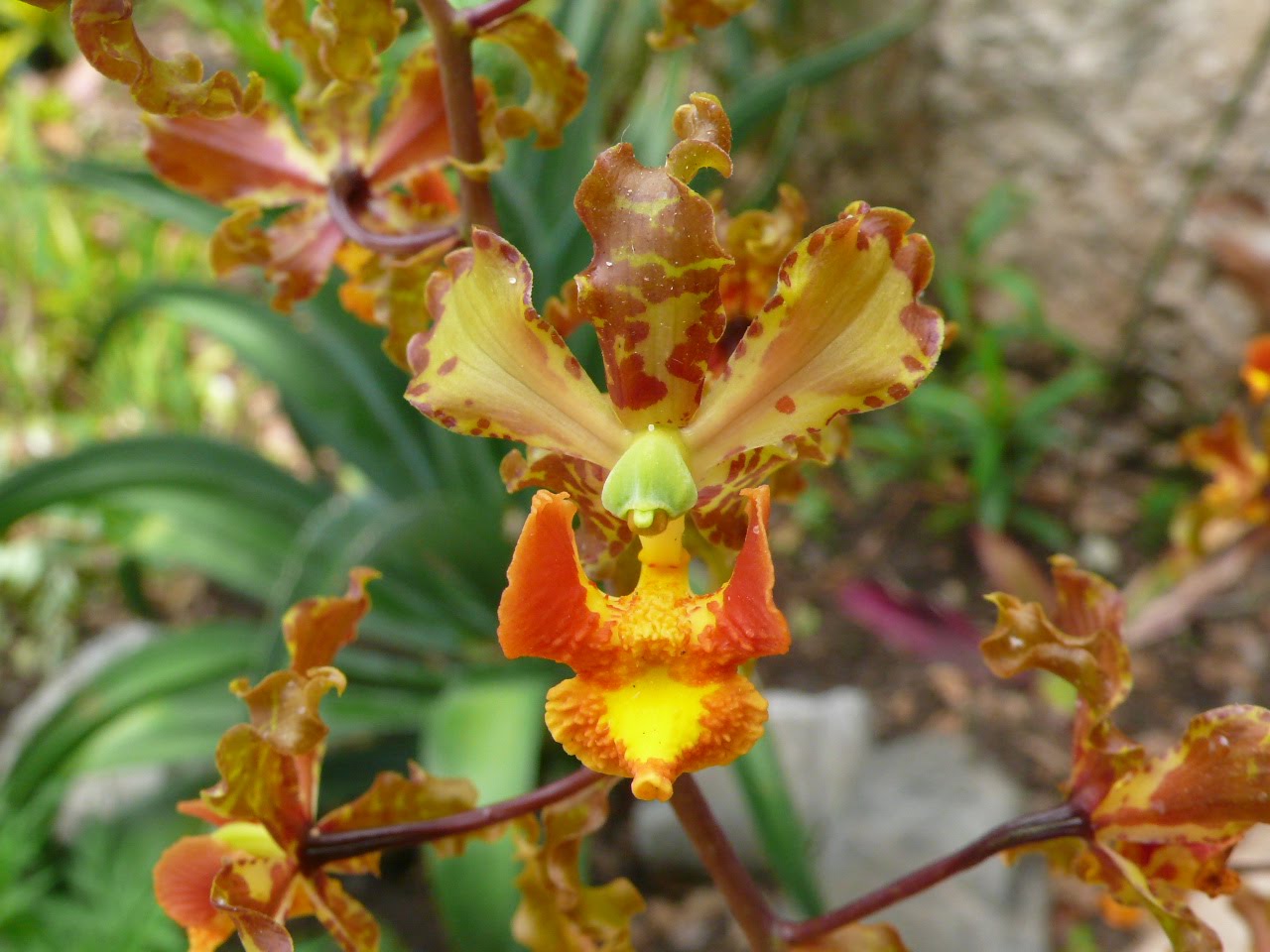
Where this orchid grows is a secret. I will say no more than that it grows somewhere in the state of Yucatàn, because I promised the friend who showed me the place that the location would remain protected. This bloom is one of more than one hundred similar blooms on a single plant. The stem on which the flowers grow reaches to above my waist; some examples are even larger. There are not just a few of these plants growing here. This is a colony of rare orchids, largely unappreciated by local residents, and therefore the plants remain unmolested.

Unfortunately here, as in places all over the world, publicity and popularity often destroy such wonders. If crowds come, there will be paths, trash, damage to the ecosystem, and flowers will be plucked and plants stolen. Many of the native orchids in Yucatàn are in danger of extinction due to agriculture, burning, and harvest of firewood, which destroys habitat. The other danger to the plants is that they are valuable. Orchids are pilfered from the wild by traffickers who sell them to collectors. I am glad that this place remains unknown, unappreciated, and in its natural state. I'll visit it to enjoy the spectacle and to take pictures, but I will not spread the word.

Friday, April 30, 2010

Living Here: Economy


When I began last year thinking about ideas for this blog I started a list, and near the top of that list I scribbled, Economy. This is the title of the first chapter of the American philosopher Henry David Thoreau's Walden, or Life in the Woods. It was in Economy that he wrote what have become probably his most famous words, "The mass of men lead lives of quiet desperation." The note was a reminder to myself that several of the chapters of this work, which I read for the first time in high school and have re-read several times as an adult, would make good models for entries in this blog. Thoreau wrote about why and how he lived alone in the woods for two years; a lot of this blog is about the why and how of living in Mèrida, Yucatan.

I was reminded of this topic again when I started reading, maybe two months ago, a blog called Hammock Musings from Mèrida, by a guy here who goes by the name of Hammockman Paul. He quotes Thoreau, and I enjoy his blog because it is thoughtful and in many ways Paul and I have similar interests and goals. So with apologies to HDT and to Paul, who has written about the economics of living here, inspired by Thoreau's detailed accounting of the economics of living by Walden Pond I am going to do the same thing.

I decided to do this because lots of friends up north seem to think that I must have become rich or have some kind of whopping retirement to be living here the way I do and at my age. And, a few are curious about the practicalities of living here. These are the ones who talk about coming down here to "check it out," with the idea of living here seasonally or permanently some day. The fact is that I live on less money than just about anyone I know up north. It's all a matter of setting priorities, simplifying and dedicating your resources to the most important and meaningful things, and not worrying about the rest. And, this can be a very economical place to live. So, for those who are curious, here is what my monthly expenses look like (converted to US dollars).

Home
First, I paid cash for my house and all improvements, so I do not have monthly rent or house payments to worry about. Although prices have risen, it is still possible here to buy a good house for about what you might pay for a nicer new car. House maintenance, things like paint, roof maintenance, electricians, plumbers and small parts and repairs (I do as much as possible myself): $100. Bank trust for the house and miscelleneous: $50. Property tax: $8. Garbage removal, curbside pickup three times per week: $2.50 per month. Electricity (I do not have AC, but run lots of ceiling fans, pool and well pumps, computer and a large refrigerator): $45. Natural gas (stove and water heater): $15. City water: $5. Telephone, which includes the local connection with 200 calls, unlimited long distance calling within Mexico, WIFI connection and rental of all associated hardware, and a low rate on international calls: $55. Cell phone (I have a plan that is pay-as-you-go, no calls, no charges): $25. House cleaner (sweeping, mopping, dusting of whole house, kitchen and bathrooms twice per week) and cleaning products: $80. Pool chemicals (I do the labor myself): $15. I stopped watching television years ago and don't have one, so I have no monthly cable bills. Home total: $400.50.

Auto
I paid cash for my used car so I have no car payments. I live in an area where you can walk to just about everything and don't drive much except for the occasional "big shop" at Costco or one of the malls, and for things like visiting plant nursuries, the beach and out-of-town trips, so monthly gas costs around $50, occasionally more if I take a long trip. Insurance: $50. Routine maintenance like tires, oil changes and small repairs: $50. Auto total: $150.

Personal
Soap, shampoo, toothpaste, clothing, shoes, and all personal and grooming items: $50. It is possible to buy good quality clothing here very economically. I get good polo shirts that last several years for about $7 each, but quality, longer-lasting jeans and shoes are a better deal in the States, so I buy there when visiting. I don't have a job to costume for, so jeans, polo shirts and running shoes or sandals are my uniform. I don't need much else. Health insurance and doctors are another great deal in Mexico. I have good private-carrier health insurance with a $250 deductible for about $100 per month. The facilities here in Mèrida are top notch, with many specialists trained in the US, and normally a doctor visit costs $45 (if one is really on a budget, it is also possible to go to a Farmacia Similar and see a general practitioner for $2). I find service to be more personalized here than up north. Personal total: $150.

Food and Fun
I don't spend a lot of money on things like alcohol, fancy restaurants or nightclubs because these things just don't interest me much. Value for the money they rate way down on the scale. However I eat out once or twice per day, and I also like to drink a coffee or iced mocha in an air-conditioned cafe in hot weather, or an open sidewalk cafe when possible. A couple of beers out with friends is an occasional pleasure. Small restaurants are one of the best deals in Mexico, with great, home-cooked food available for $2 - $3 per person. It's often cheaper for me to eat out than shop and cook at home. Cafes and eating out $250. Food, beverages, bottled purified water, movies, other going out and miscellaneous purchases $100.

I often shop at the local markets, where yesterday a friend found these mangoes for five pesos per kilogram, or about eighteen cents per pound. Coffee is another bargain here. Mexican coffee is among the best in the world, and I am picky about my coffee. I buy rich, fresh whole bean roasted coffee, prima lavado from the mountains of Veracruz for about $5.50 per pound. There are numerous regular cultural events that are free or low-cost. First-run movies at the theater three blocks down the street cost about $2. Food and Fun total: $350.

Total for all of the above: $ 1050.50. My monthly household budget is about $1050. Art, books, recorded music, gifts, furnishings, the occasional other luxury, computers, other technology (which is minimal) and travel are not included in that amount.

Travel
This one is not included in the above budget because it is variable and I do not consider it part of the cost of living here. It is my largest annual cost along with food. I travel to Alaska two or three times per year to see family and friends. I also travel quite a bit within Mexico; it's quite economical because high-quality long-distance buses and reasonably-priced hotels are the norm. I rarely pay more than about $35 per night for hotels and often pay less. A week-long trip I took last fall to Oaxaca, including round-trip airfare from Mèrida, three restaurant meals per day, concert tickets, taxis, buses and six nights in hotels set me back about $600.

In Economy, Thoreau wrote: "Most of the luxuries, and many of the so-called comforts of life, are not only not indispensable, but positive hindrances to the elevation of mankind." I continue to work at simplifying my life because I have found that by not having to work excessively to acquire and maintain unnecessary luxuries, and by simplifying my comforts, I have been able to afford an abundance of the priceless, the greatest luxury of all: time.

Thursday, April 22, 2010

Getting into Mañana


I wrote last week about thoughts that came to mind when a neighbor passed away. He was a pretty happy and successful guy, mostly due to his attitude and priorities, as far as I can see. Well, I posted that piece on the blog here nine days ago, and two days ago started stressing because I am not meeting my self-imposed schedule of one blog post per week.

There's lots of other stuff on my to-do list that isn't getting done, either, and I find myself worrying about it. It's part of my upbringing to meet deadlines, stay on schedule and accomplish things. This attitude is part of American culture, and one of the reasons that the United States has been highly successful in the world doing certain kinds of things. At any rate, lately for a variety of reasons, my days have been full but the long to-do list doesn't get smaller.

Let's see, yesterday, instead of folding a mountain of laundry that's been there since Monday, and buying glass for a new window, I spent a couple hours going over drafts of poetry translations for my friend Jonathan, and then spent a couple more hours, when he stopped by later, talking about them, drinking beer and eating spaghetti.

Today, when the guy who I pay to sweep and mop floors couldn't make it to work, I spent five minutes hitting the bad spots and decided the rest of the mess can wait until next week. Then I climbed on the roof. I have been planning for some time to re-coat the roof this month because this is the height of the dry season, the best time of year to do it. Trouble is, starting a couple of weeks ago, just when I was ready to scrape, clean, patch, and put down a new coating of waterproofing, or impermeabilizante, it started to rain. You can't coat a damp roof, so after it rains it's best to wait a few days. Each time I thought things had dried out enough to start work, it rained again.

This morning I was all ready when the temperature dropped and the sun disappeared behind gray clouds. Time to punt. I finished all of my preparation, quickly put a light coating of impermeabilzante on a couple of trouble spots, and left it for another day. I'll be optimistic and make the rain work for me. One more rain will wash away the last bit of dust up there, making the perfect clean surface for the new waterproof coating.

So today, I also have errands, banking, the blog...

Oops! I just got a call from Padre Luis, the beekeeping priest in Manì. He's starting his honey harvest in the morning, and invited me and a friend to come down and stay over a night or two to observe and help. This is something I have been looking forward to since meeting him last month. I've got to get clothes, hammocks and a few other things organized, and put gas in the car for a very early start tomorrow. And Jonathan told me he is looking for a ride out to the hacienda. That means picking him up bright and early and dropping him in Tekit on the way to Manì. The next three days are full. Looks like not much else will get done around here until next week.

One thing, though, I have something like 35 ripe tomatoes from the backyard garden and I can't keep up with them. I bet I have time to make a batch of spaghetti sauce this evening and put it in the freezer. I have onions and garlic. Good. That's important.

So today, laundry, window glass, errands, banking, the blog. Hmmm. The blog. Well, the topic I'd planned for this week will take quite a bit of time; I'd need to organize photos and my thoughts, and spend a couple hours at the computer. No time for that, so here is this week's post.

The rest of the things on my list? I'll have to get around to them mañana. And actually it looks as if mañana will stretch into late next week.

Powered By Blogger