Showing posts with label architecture. Show all posts

Saturday, December 17, 2011

Architecture: The Colonial Obsession


This is a photo of the street where I live. Interestingly, although I live in the center of colonial Mérida, there is not single authentic colonial building in this image.

I ought to clarify my terminology. To me, "colonial" is something dating from the colonial era, and built by the Spanish before Mexican independence in 1810. Anything newer might be "colonial-style," but it's not truly colonial. The houses in the picture above, including mine, were mostly built within the past 100 years or so on land that probably was a patchwork of cultivated areas and smaller, less-durable structures, such as Mayan houses, in colonial times. There are two or three buildings on the other side of my large block that might be colonials.  But the houses in this picture were most likely built when the spacious lots that surrounded most early homes, sometimes called quintas, were subdivided between heirs or sold off as Mérida urbanized in the 19th and 20th centuries.

I started thinking about the obsession with things colonial when I noticed that a house on my block, which has been renovated by a foreign investor as a vacation rental and is now for sale, being advertised as a "200-year-old colonial." The fact is that although the house has a traditional facade, it is a 20th century house, with steel I-beam-supported ceilings, probably built during the 1930s-1950s. The investor had the entire structure demolished except for the facade and front room, and behind this built an ultra-modern two-story home, painted in bright colors. One of the few original interior details that was preserved, a squarish entry arch, is very Yucatecan, but the Spanish never built anything like it during the colonial era.

The same investor also bought another house nearby, which before being altered unrecognizably inside was also a nice traditional Yucatecan structure, but likely not more than 70-90 years old. Now renovated this, too, is being advertised as a "colonial."

A twentieth-century home recently turned "colonial"
Then I noticed a large crew of albañiles, construction workers, laboring on a recent Sunday. Sometimes when construction crews work on Sundays it's because they've got a deadline, but more often it means that they are working on a project without permits. Sometimes the permits are impossible to get because the homeowners want to change the appearance of downtown historic buildings that are regulated by INAH, The National Institute of Anthropology and History. So, people do what I call "Sunday projects," which are completed quickly over a weekend when regulatory officials are off work. By Monday morning everything is cleaned up and no one remembers anything about it.

This Sunday project was a house probably built in the 1940s or 1950s with higher ceilings, nice spacious rooms and a unique, very interesting facade. I saw the owner and asked him what was going on. He told me the facade needed to be "more colonial."

That's too bad, because Mérida has a lush architectural history, of which the colonial era is one aspect. To make it more interesting, many of the true colonials, often very plain structures, were modified with European and Victorian flourishes during the 1880s through the early 1900s hennequen boom when Mérida property owners had lots of money.

Twentieth century styles
Mérida also has a lot of nice Beaux Arts, Art Noveau and Art Deco buildings, along with interesting Mexican versions of these and 40's, 50's and 60's styles. These frequently are influenced by Mayan design, which preceded the colonial era and is the true native Yucatecan architectural style. Unfortunately these buildings often are not appreciated for what they are, and in fact some even show up on local real estate web sites labeled "colonial." And uninformed colonial-obsessed buyers often take the bait hook, line and sinker, thinking they are buying an authentic colonial. Then, if their new houses don't seem colonial enough, they go columns-and-arches crazy, and add the colonial touches they feel are lacking.

Traditional Yucatecan, not colonial
I have seen many lovely homes of various styles turned into fake colonials. One of the saddest examples is a very nice original art deco home with curved walls that was wrecked when all of the deco details were chipped off its facade. Then brand-new colonial-style doors and windows replaced the beautiful porthole-window originals of wood and wrought iron. A great many nice old Mérida buildings have had unique Yucatecan architectural features erased and pseudo-colonial facades added in recent years.

I can understand the interest in the colonial era. Colonial design is often very beautiful and is functional in this climate, with high ceilings, interior courtyards and large doors and windows. However real colonials in Mérida are not as common as people think. Many are more like my traditional house, which possesses many colonial-style design features, but although it is very Yucatecan, it is not colonial.

Although the colonial influence is still extremely prominent in Yucatán, this region's architectural history is a lot more diverse than that. I think it's sad that fascinating slices of the legacy are being homogenized and lost in the name of this obsession with the "colonial."

Saturday, November 19, 2011

Anthropology: Urban Vestiges, Part 3 -- Abandoned


When I was a kid, I was fascinated by ruins and abandoned houses. I still am. So, since moving to Yucatán, where uninhabited haciendas litter the countryside and empty mansions still dot the Mérida inner-city landscape, I am in a kind of heaven.

A friend of mine sells real estate. As a dabbler in the business myself, sometimes I tag along to take pictures for her, just to have an excuse to nose around old houses and maybe find an interesting opportunity. One day I went with her to look at a house that the owners were putting on the market. The prior owner had died years ago and left the home to relatives, two of whom met us on the street in front of the high, decorated facade of the colonial-style structure.

Many keys were produced, but none seemed to work in the lock. All the keys were tried a second time, and this time one was found to rotate slightly. A small can of oil was located, and with liberal application of lubricant and gentle force, ultimately the lock was made to open. Then the door, apparently swollen by humidity and its hinges stiff with corrosion, would not budge. Finally after some kicks and heavy shouldering, the door scraped open. A large pyramid of unopened mail from banks and utility companies had accumulated beneath the letter slot. This yellowed, wrinkled heap, which with dampness had congealed into a pulpy mass and stuck to the floor, had been partly to blame for our problem with the door. Along with this, the reek of rodents, humid, stale air and enough hanging cobwebs to furnish several Halloween Haunted Houses were evidence that no one had been inside for a long time, perhaps years. One of the owners would not pass over the threshold. He didn't say why. He peered inside while standing safely back on the sidewalk, and then returned to wait in his air-conditioned car.

The interior was much the same as in many of these forlorn old Mérida homes. There was a story here of a life, in this case of a man who had passed away years ago, leaving roomfuls of furniture, files and hoarded treasures to heirs who didn't really care to deal with the mess and did not want to live in an old, crumbling house in centro.

Another old home near mine also was uninhabited for many years. It was easy to see through cracked, uncurtained windows that it remained fully furnished in the style of the 1930's, with crystal chandeliers, bric-a-brac, old paintings and family pictures still intact. A dusty baby grand piano was clearly visible through a missing pane in the padlocked and chained front door.


In some of these cases,  there are numerous heirs who can't agree, or there is no will, so houses remain locked up and in limbo for years, sometimes decades. An acquaintance of mine tried to buy a fabulous old home whose owners had died intestate in the 1920's. Their numerous children and many of their grandchildren were now also gone, leaving dozens of great grandchildren and other relatives to dispute the estate. The family feud over inheritance is so intense that no one lives in or cares for the property. Likely the dispute will continue until the house falls down or is confiscated by the government as a nuisance or for back taxes and bills. There is a beautiful old house on my block that's been in much the same situation since the owner died in 1951. The remaining original heirs, who would like to sell, are now in their 90's. I suspect none of them will ever see their money.

Occasionally, a house you might think abandoned, isn't. It turns out an ancient man or woman, or sometimes a younger family, to all appearances without funds to maintain the place, hangs on, often living in a couple of back rooms that are still in habitable condition. They may be owners, heirs, caretakers or squatters. Whatever the situation, it's interesting to see a fabulous casona still in use, but with chickens running in the gardens, laundry drying along the colonnades, and humble hammocks swinging beneath ornately stenciled, beamed ceilings.


I appreciate the restoration efforts that have brought many old Mérida homes back to life, but feel it will be a sad day when progress has eliminated the last of the abandoned and ruined old mansions. These old, un-beautified relics are romantic time capsules. They add a touch of color and mystery to the city.

These remnants also remind us of the glories and follies of the past in a way that restored and modernized examples do not. They help me keep in mind the temporary nature of everything on this planet, and particularly the fleeting qualities of wealth, status and power, which many of these crumbling edifices were constructed to symbolize.

If you enjoyed this post, you also might like Wanderings: Hacienda Dreams, Urban Vestiges Part 2 -- Stones, and Urban Vestiges, Part 1.

Friday, May 14, 2010

Anthropology: Urban Vestiges, Part 2 -- Stones


There are places in Mèrida, Yucatàn, where once an elaborate archway welcomed people, and now there is a wall. Where once an important structure stood, now there is open space. I wrote in March about some of the unheralded bits and pieces of history that can be found in this city, evidence that tells stories about how
things were, and how places and spaces have changed over time. Sometimes the parts of the structure still exist, but in new arrangements. It is an interesting puzzle that I love to contemplate.


Many of the buildings in Mèrida Centro were constructed by the Spanish. Starting in the 1500's when they occupied the Mayan city of Th'o (sometimes spelled T-hò) on the site, they began demolishing the Mayan buildings in order to use the stone for constructing their new city. A large number of these early colonial structures still exist, although after hundreds of years of use, remodeling and reconstruction, many have been dramatically altered.

The style of this balcony window on a downtown Mèrida building (above) is one popular in Mèrida from the late 1800's into the early 1900's. During this period, when the city was rolling in money from the hennequen trade, many new structures were built and many older ones, like this building, were modernized to keep up with architectural tastes. The piece of an earlier Spanish colonial arch visible to the right of the window, possibly 400 or more years old, was uncovered when the facade was restored a few years ago. It strongly resembles the doorway on an unaltered colonial-era facade a few blocks away (above right). The "disappeared" colonial second-story window of what

originally was a home may have protected the honor of señoritas of the household from the gazes of rough men on the street, and their sensitive skin from the burning rays of the hot sun, while providing light and air to the home's interior. Now looking down on a congested, noisy street, this appears to be space that is unused, or perhaps devoted to storage, above what now are small storefronts on the street level.

When the Spanish arrived here, they discovered a sizeable city with a pyramid at its center. That pyramid was situated on space that is now Mèrida's Plaza Grande, or central square, also known as the zocalo. The Spanish conquerors dismantled the pyramid, stone by stone, quarrying its materials to build many of the structures that now surround the zocalo, including the Catedral de San Ildefonso, the oldest cathedral in the Americas, which still dominates the scene.

I am told that it is possible to see original Mayan carving on some of the stones in the cathedral. Although I have walked around in and outside the cathedral in search of them, I have yet to find these stones. I'll have to ask someone who knows more about the building where to see them.


Another interesting feature of the cathedral is the presence of slits in the facade, which would allow defenders to shoot down on the approaches to the front doors. From time to time, from the conquest up until the late 1800's when The Caste War, La Guerra de las Castas, finally fizzled out, violence erupted in Yucatàn between the indigenous people, who mostly lived in the countryside, and the descendants of the conquistadores, who mainly lived in a few larger towns, the most important of which was the capital city of Mérida. In case of serious conflict, one of the defence tactics was for the population of take refuge in some of the stronger central buildings, including the cathedral. Many of these structures in the center of the city are connected by a series of tunnels. Some of these were re-discovered only in the past few years.

More Mayan stones, which quite possibly also came from the pyramid, can be seen here, partially exposed in the facade in another original 1500's building, just across from the Cathedral and the zocalo, which otherwise has been greatly changed over the centuries.

It's fascinating for me to think that most of the original pyramid of Th'o actually still exists in Mèrida. It's like an enormous jigsaw puzzle whose pieces have been scattered and mixed up for close to 500 years. The pyramid's footprint is evident in the form of the zocalo. It's a bit late and entirely impractical to think about putting the pieces back together, but it's interesting and comforting in a way to know that although we don't generally recognize it, the great pyramid of Th'o is still with us. In fact, when we walk in the vicinity Mèrida's zocalo, it practically surrounds us.

Thursday, March 18, 2010

Anthropology: Urban Vestiges


I really enjoy looking at architecture and the bits and pieces of cities that inform us about the past. It is easy to overlook sometimes that although evidence of the past may change form or context, it is still with us. Matter and space do not disappear; it's the arrangement that evolves.

I recall peering out a seventh-floor window of the Mendenhall Apartments in downtown Juneau, Alaska, where I lived, on and off, for many years. One day in the 90's I noticed, high on a building nearby, on a side now hidden from street level by more recent construction, a peeling, antique-style black painted sign for the San Francisco Bakery. The bakery was still there under another name when I was young, but the San Francisco logo was probably out of use before I was born. From the style of the lettering I guessed the sign was likely from the pre-World War One era. I did a little checking. The business opened in 1914. Bingo! What I noticed was possibly an original sign, long ignored and unnoticed, that continued nevertheless publicizing an enterprise, now closed for decades, that was selling bread when my grandparents were children. Although the ovens are now next door and the old bakery space is a dining room, the bakery tradition is continued in the same place after almost 100 years, now operated by the Silverbow Inn.

I also remember a multi-colored, billboard-sized 1937 Chevrolet ad painted on the side of an old brick building along Alaskan Way in downtown Seattle, which was visible from my earliest memory until the wall was altered or demolished maybe 15 years ago. I miss that sign. It was a little piece of history, forgotten and unappreciated, that spoke to me from the past. It is these kinds of experiences that have fed my interest in the detective work of discovering details about the past from the vestiges that survive, often unappreciated or uninterpreted, today.


Mèrida, where I have lived for the past few years abounds in these kinds of clues. And since it is a very old place, having been a thriving Mayan city before the arrival of the Spanish in the 1500's, the vestiges of the past are varied and fascinating. I started thinking about all this some time ago when I began passing over the above advertising message, fired on tiles set in the sidewalk. It's placed like a welcome mat in front of the doorway to an abandoned building a few blocks down the street from my house.

The corner building, whose unadorned architecture and location indicate that it's quite possibly a true colonial-era structure, apparently once was a pharmacy that sold, "Roberina, 5 centavos, cures headache, toothache, rheumatism, colds." I wonder if Roberina was a patent medicine, or perhaps as a friend suggested, something made in Mèrida of local herbs. That is very possible. There is a vast treasury of traditional medicines used by the Yucatecan people, even today.

On my way to take the pictures above, I passed by this plaque on a building that stands at the corner of Calle 57 and Calle 70, not far from home and almost at Parque Santiago.

These plaques are to be found at intersections all over the historical center of Mèrida. In days when only clergy and the wealthier classes were literate, the rest of the people needed a way to navigate and find things around the city. Many of the important intersections were named after landmarks, objects or animals, and if necessary signs or sculptures picturing the identifying names were installed at the crossings. I live nearest the corner of "Los Cuatro Vientos," The Four Winds. Also nearby is the corner of "Dos Soldados," Two Soldiers. The Robelina ad and abandoned pharmacy is at "El Cardenal," The Cardinal. That plaque is visible in the photo of the building (above).

El Coliseo, The Colisseum, was the original bull ring of Mèrida, situated at this intersection which still bears its name. I figured out where the structure was located after seeing this sign. I noticed that, in a neighborhood that consists of very old buildings, there are two blocks, near this intersection, of much more modern architecture. When El Coliseo was torn down and replaced by a new structure in a different location several decades ago, houses and businesses were built in its place. So, although the original structure no longer stands (what a shame), its shadow remains still, for those who are willing to see it. A large and beautiful painting of El Coliseo, by the Yucatecan painter Mario Trejo Castro, hangs in the cafe La Flor de Santiago, on Calle 70 just around the corner from the plaque and a stone's throw from the site of the old bull ring. La Flor is a venerable establishment dating from the 1920's. I suspect in the old days that many of the conversations echoing off the cafe's walls were uttered by customers stopping in for refreshment either before or after going to a corrida at El Coliseo.

There are many more, often more ancient vestiges apparent to a person walking observantly around this city, and I plan to write more about them. However, this week I am going to end with evidence of a modern
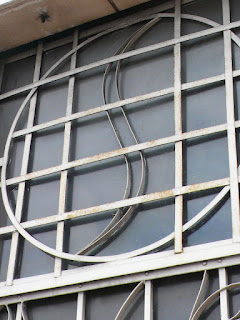
corporation that did business in Mèrida, and was practically a household word in the United States through the middle of the last century. The above logo, incorporated into metalwork above the unused side door of a well-known downtown building, now a hotel, provides a clue. What was the name of the business, and what did they sell? To the person who first posts the correct answer below in the comments section of this blog, a free lunch for two at El Principe Tutul Xiu, one of the finer Yucatecan-food restaurants in Mèrida. Or, if the winner prefers and provides the transportation, I'll buy at the original location of this same restaurant which serves delicious poc chuc and other fine traditional dishes in the pueblo of Manì, Yucatàn, a place also rich in fascinating clues to the past.


Wednesday, February 3, 2010

Yuctecan Still Lifes: A Walk Around the Corner


Assignment: See what kinds of photos I could make on my routine walk to the store around the block where I buy the morning paper. The round trip takes less than ten minutes, and I did not allow myself to take much more time than I normally do, nor deviate from my normal path. This means not crossing any streets: to get to the store I turn left out of my front door and walk to the corner where I make another left, and continue to the next corner where I turn left once more. Tendejon Miguelito is a few doors down the way, just about back-to-back with my house. I walked to the store, observing, and bought the newspaper. On the way home, I took pictures. They reveal details about life and culture "por mi rumbo," in my neighborhood.


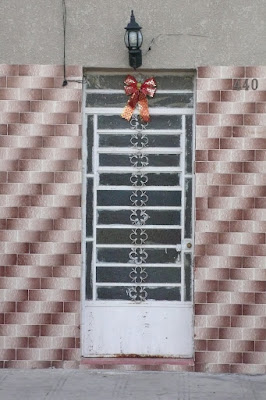
#1. (above) A barred security door, propped open against the wall of a house. Someone slipped an advertising flyer into the bars. This is a daily occurrence in Mèrida, where many families do not have internet or receive the newspaper. Advertising is often done via these types of leaflets.

#2. Trash in a planter. Some wrappers, a plastic spoon, a bottle, two chunks of cement and what appears to be a photo of a child soldier in the Mexican Revolution have been discarded in this planter in front of a home.

#3. Old bakery. This late 19th or early 20th century-style building has been empty ever since I moved onto the street. During the Yucatàn hennequen boom of this time period many Mèrida buildings were renovated or built in this Europeanized style. I am told this once was a factory or a bakery. Some of the original wooden doors, like the one on the right, were replaced by modern steel overhead doors, a common practice over the years here in Mèrida where a good proportion of the oldest buildings were converted to industrial, retail and warehouse use. For years this building has been for sale or for rent, but nothing ever seems to happen. Recently workers have been painting, cleaning and renovating the facade. The sacks contain some of the rubble and debris from the work that presumably will be hauled away some day.

#4. Renovated house. These neighbors decided to redo the facade of their old house, creating a garage door where once there was a window, and putting ceramic floor tile on the lower part of the facade. Supposedly these types of alterations in the Centro Historico are prohibited, but many flaunt the rules. Or perhaps this house is modern enough to be exempt. Maybe no one noticed. Whatever the facts are, they redid the front of the house. It's not exactly to my taste, to be gracious about it, but everyone has a right to their own aesthetic.

#5. The carpenter car dealer. This building is just about five doors down from my house. The guy, who seems to be a Chilango (from Mexico City) and is definitely not Yucatecan, used to build and sell furniture, tables, chairs, shelving, beds, things like that. Now he seems mostly dedicated to selling used cars. These he often has parked along the street while leaving his huge private parking lot empty, taking up a lot of the limited public parking and annoying some of the neighbors. However, mostly he seems to play very, very loud music and invests his time cruising around in a convertible, top always down and with his elbow resting on the window ledge, or holds court on the sidewalk with a six pack and various neighborhood characters. You get the idea. About a year ago, he built this coffin, and it has been outside leaning against the front of his shop since. Maybe the person who ordered it got better. Maybe the buyer put off making his last payment until it was too late. Or maybe the carpenter made it as a joke. He did have the lid open and a mannequin dressed up like a monster laying inside for Halloween. I like it; brings up the neighborhood a bit. Best thing that guy's done around here.

#6. Neighbor's door. Frankly, looking at the front of this house with any kind of concentration gives me vertigo. Fortunately it's not directly across from my house, so I don't get dizzy walking out the door. A lot of homes in the city have some tile on the facade because it is more durable and requires less maintenance than a painted surface. This tile pattern apparently was fairly popular some years ago.

#7. Gilda's tree. This is a piece of a flor de mayo, or plumeria tree that my neighbor and friend Gilda put out against the front of her house to be taken by the trash collectors, who apparently balked at hauling it away. After resting there for a few days, it fell over and stayed that way, as you see it here. Right after I took the photo, someone collected it.

#8. Neighbor's plant. Three doors to the north of my house is a very old, very traditional home. When the doors are open you catch glimpses of chandeliers, paintings and old furniture that look like they have been there since great grandma's day. In the front garden there are several potted plants. This is one of them, in front of a window grille.

Powered By Blogger