Sunday, August 8, 2010

Nature: Close Up


I haven't posted much recently because I've been traveling and had quite a bit of work. I got home early last week and was submerged in piles of details for a few days, but on Friday I got away and spent some time in the country. The "excuse" was to get some potting soil and incidentally to explore a highway I'd never been on. After more than three weeks living out of a suitcase, teaching summer school to adolescents and spending a lot of time in airports, bus terminals and cities, I needed some quiet time.

After buying an icy refresco in a small pueblo about 40 minutes south of Mérida, we pulled onto a side road that runs a long distance through fields and trees where I was assured no one would care if I filled a few bags and buckets with the rich red soil found there. Working close to the earth, digging, and sorting out rocks and roots with your hands you end up noticing things that otherwise you wouldn't. The rivulets of sweat that I couldn't wipe from my eyes because my hands were too dirty did not keep me from spying this iridescent blue-green beetle about the size of a walnut scurrying away from the shovel. It must have been under some leaves we disturbed with the pick axe. After detaining it long enough on a stick to take its picture, I let it go.


The next resident found under the leaf litter was this fat caterpillar, in its curled position looking a lot like a prehistoric Ammonite shell fossil, and just as still as one. No matter what I did to prompt it to move so I could see the motion of its many centipede-like legs, it showed no signs of life. We left it where it lay and replaced the protective blanket of leaves that we had disturbed.

Digging through leaf litter we found a lot of scorpions, alacranes in Mexican Spanish. It looked as if eggs had just hatched. There were many small scorpions such as this one, posing next to the tip of my pencil. I don't believe I have ever seen another this tiny. Small as it was, I did not touch it, assuming that although tiny, its venom still packs a punch. I did not want to test the theory.


A nearby tree was the next thing to catch my attention. The peeling bark of this tree sloughs off in large sheets, leaving fresh light-colored new bark beneath. As the newly-revealed bark ages it turns green in patterns created by the stencils of the fallen bark, then slowly assumes the rough reddish-gray color seen here. Then it, too, dries, separates, and falls in large curling pieces to leave new white under bark exposed to the air and light, beginning the process once again.

Once I started looking at the trees I saw this butterfly, at first with its wings folded and exposing only the dull gray undersides, which blended well with the tree bark. Suddenly it began to open and close its wings, flashing me with these bright neon-blue stripes. From a distance this movement contrasted against the shaded dark side of the tree really does resemble a light being switched quickly on and off. The butterfly did not seem disturbed by my presence. I was able to approach closely and take my pictures without startling it.

I often have the opportunity to observe tourists and it seems that they are normally drawn to in-the-face spectacular, big things, like pyramids and breathtaking ruins, the architecture of historic Mérida, long white beaches, red sunsets, and contrived, garish, over-the-top attractions like Las Vegas and theme parks. One of the nicest aspects of living in Yucatán is that, along with treasures like Chichen Itza, the coast, beautiful cenotes and lovely colonial towns, there is a never-ending wealth of smaller attractions awaiting discovery, not quite so obvious, but just as rewarding.

Saturday, July 24, 2010

Nature: Mariposas

Not long ago I was carefully making my away along a back-country road when, as I gained distance from the main highway and got further into monte, I noticed the increasingly thick clouds of butterflies, like animated yellow, white and green snowflakes, rising in front of my car. This time of year it is normal to see a lot of butterflies, mariposas, and the farther away you are from the contamination and chemicals of towns and agricultural areas, the more you are likely to see.

Along dirt roads during the rainy season, which we are in the middle of now, butterflies tend to congregate in the heat of the day to rest in shady areas and ruts where there is mud or dampness left from the last rainstorm. Here is what I found that day.


I apologize to my friends who knew me as a professional photographer and producer, and may expect a little higher quality. I was exploring and not out to make video that day. I had one shot at it with a handheld point and shoot camera on a dying battery. It's still a marvellous sight...just another of the many little surprises you encounter when wandering around Yucatán.

Wednesday, July 14, 2010

Mystery: La Princesa, Part 2


Last week I posted the story of La Princesa, wife of a 19th-century owner of the Yucatán hacienda San Antonio Xpakay who was brutally murdered by her husband for infidelity with a hacienda employee. She bled to death in the main house, known in Yucatán as a casona, more than 150 years ago, but locals believe that her unhappy spirit still lingers on the hacienda. Verse by the Mayan poet Briceida Cuevas Cob, translated into English by current San Antonio Xpakay owner Jonathan Harrington, helps tell the story.

When Jonathan bought San Antonio Xpakay about ten years ago, there was a family that had been on the hacienda for twenty years still living in one of the houses, and Jonathan kept them on for awhile after he moved in. Jonathan reports that Basilio, long-time hacienda employee and father of the family, his wife and children all had stories about La Princesa.

...in these moments in which the blood of the sun
is scratched by the limbs of a tree
like the blood of my heart
is scratched by the claws of solitude. (1)

She appears as a faint female figure normally seen at a distance, wandering around the grounds in the evening. She is beautiful.

The children reported seeing a lone female moving along the albarradas, or stone fences, at the far ends of the garden. And they were pretty sure it wasn't just some neighbor. San Antonio Xpakay is located in the midst of wild monte, which is forest or what we in Alaska might call The Bush, kilometers away from the nearest pueblo or other house. It is reached by traveling over horse trails or rough ranch roads and has no close neighbors. The area is remote, can be dangerous, and is an easy environment in which to get lost. Occasionally in the Mérida newspaper there appears a story about a skeleton or just a few scattered human bones found in the monte, which if they are ever identified, usually turn out to be the remains of someone who had been reported missing. Authorities and family members often can only speculate how and why the deceased died alone in el monte. The wild country around San Antonio Xpakay is not the kind of place where someone, especially a woman alone, would be out wandering in the moonlight.

Basilio's family did not go out at night.

Night falls, and the crickets begin to sing again,
once again the night sinks into my sadness. (2)


Late one night not long after moving in, Jonathan was asleep in his bedroom in the casona when he was awakened by the clap-clap of sandaled footsteps on the tile floors. He went back to sleep and thought little of it until the next day, when he casually asked Basilio why he had come into the house in the middle of the night. Basilio swore that he had stayed in with his family after dark, and had not been in the main house the night before. Basilio was not surprised because the explanation was easy: it was just La Princesa.

After posting the first part of this story last week, I decided to go back out to

the hacienda to talk once again with Jonathan about La Princesa and to take more pictures. Although the murder room (right) has undoubtedly changed a lot since La Princesa died here more than 150 years ago, it still exists just off of a main living area used as a guest bedroom, where I usually sleep when I visit. The large room measures five by ten meters, with six meter ceilings (16 by 33 feet with 20-foot ceilings). It is sparsely furnished with several small tables, shelves, and a bed with mosquito net, and is accessed by three doors and two windows.

When I arrived at San Antonio Xpakay, Jonathan was not there, so I located a hidden key and let myself into the house. It was afternoon, so I put sheets on my bed, readied some food I had brought along, and after a short walk decided to take a siesta while I waited for him to get home. Laying on the bed, I looked straight up at the high ceiling, with the mosquito net, designed to cover the whole bed and lowered on a rope by means of a pulley attached to a ceiling beam, directly over my head. The drape of the suspended mesh reminded me of the hems of an old-fashioned woman's dress. I began thinking about my first night in this room, several years ago.
On my first overnight visit, after a long day on the hacienda and in the nearest pueblo, we stayed up late in the dark, sitting on the front terrace and talking. Jonathan had told me stories about the hacienda, mentioned that there had been a murder in the house and that people believed that the ghost, called La Princesa, still haunted the area.

Finally I went to bed in the big room, and Jonathan went to his adjoining bedroom. Nights in the country can be noisy, and when you are not accustomed to the variety of sounds, it takes awhile to get comfortable and to sleep. I am not accustomed to sleeping in such a large room, and it is not cozy, with its numerous open windows and doors.

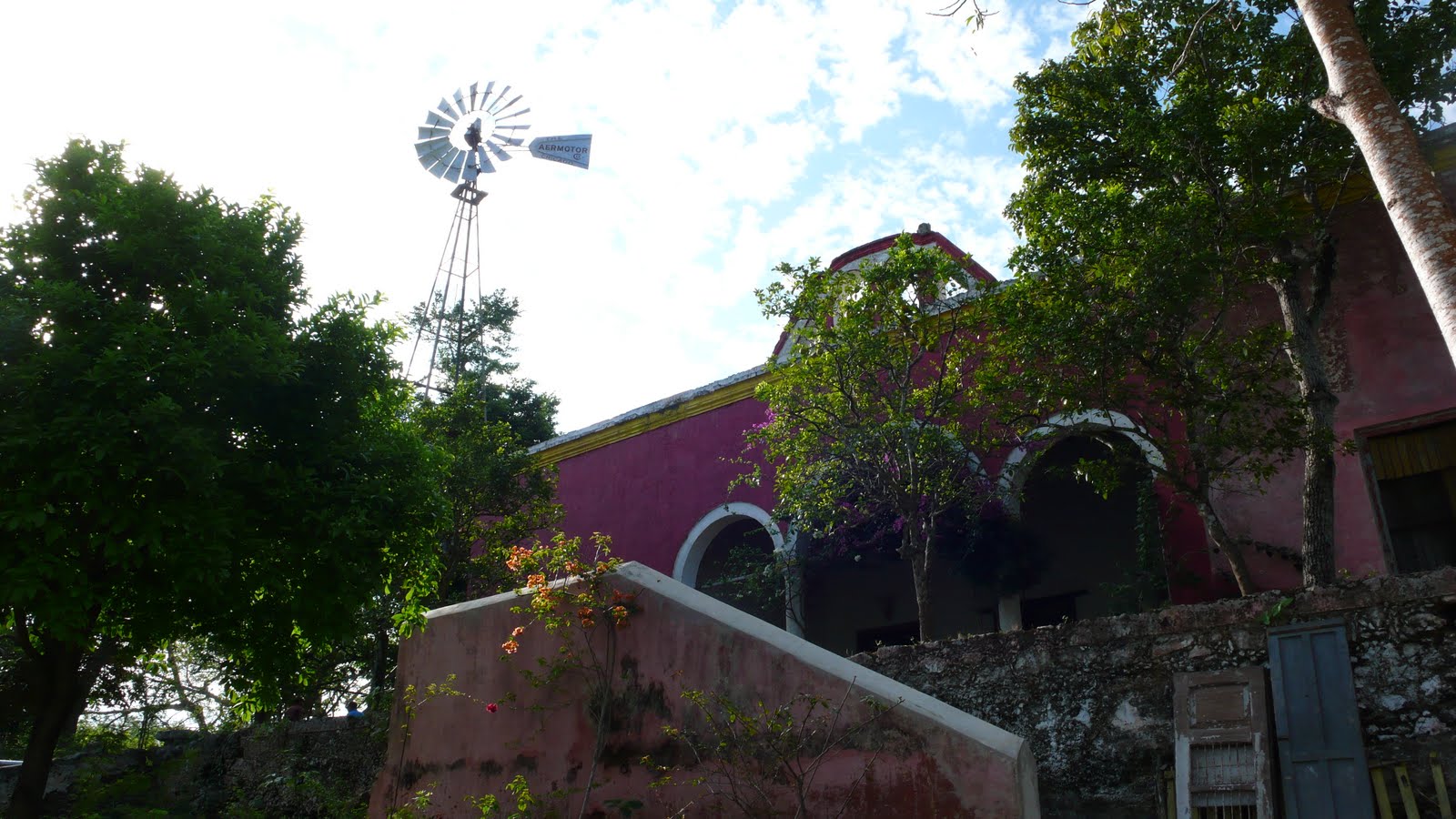
It took me a long time to get to sleep. Besides all of the noises, including frogs, crickets, owls and other night creatures, the house has its own set of sounds: creaks and bangs of the old metal kitchen roof, scurryings of unidentified creatures, the sounds of the metal windmill and its tower, and many small knocks and rustlings.

Although there were not many insects about, I had lowered the mosquito net over the bed. In the candlelight it glowed a soft yellow. Another candle flickered twenty feet away inside the bathroom, where La Princesa died so long ago. It took me awhile to get there, but I slept.

In the middle of dreamless sleep I suddenly awakened with the feeling that someone had closed a cloth bag or pillowcase over my head. Although I lay in the middle of the double bed and the mosquito netting formed an ample tent overhead, the netting from the right side of the bed was now pushed inward toward me, covering my face and head. Startled, I lay still for a few minutes, listening and moving only my eyes back and forth in an attempt to figure out what had happened. Sensing nothing, I calmed down and rearranged the netting. Although I observed no air movement, I attributed the event to a maverick wind blowing through the open windows, and after tossing and turning for a good long time, eventually went back to sleep.

Now you suffer.
You remain in the sounds of the deaf night. (3)

Later, I was having one of those dreams in which I am scared, being chased or hiding from something that I never can quite recall after I awake. Suddenly it GOT me. I was enveloped and suffocating, and I awoke with a gulping for air, to find the gauze of the netting again in my face and over my mouth. This time I did not stay still, but bolted up and groggily pushed the net quickly away with a flailing of my arms. I sat still and looked around the room. Not a breath of wind wafted through the windows, but again the tent was deformed, the netting to my right pushed inward toward me. I could see that the candle in the room where La Princesa died was no longer burning. Nothing else was disturbed. I wanted to say something out loud, but I didn't know what to say, or to whom.

Where is your voice?
Where have you lost it? (4)

I never figured out what happened and it does not matter. There did not seem to be wind, and my arms were not tangled in the netting when I twice woke with a start, so I did not think that I had somehow pulled the material over onto myself. It was an interesting experience and it makes a good story, no matter what the cause. Although I like to think that I had an encounter with La Princesa, it will remain another of the occasional mysteries I come across around here that keep life interesting.


Notes:
(1) from the poem, In These Moments, by Briceida Cuevas Cob, translation (in draft) by Jonathan Harrington.
(2) from the poem, Like the Morning Star, by Briceida Cuevas Cob, translation (in draft) by Jonathan Harrington.
(3) from the poem, Hypocritical Moon, by Briceida Cuevas Cob, translation (in draft) by Jonathan Harrington.
(4) from the poem, Your Voice, by Briceida Cuevas Cob, translation (in draft) by Jonathan Harrington.

Wednesday, July 7, 2010

Mystery: La Princesa, Part 1

On a recent Friday night I slept in the midst of el monte, or forest, and it was the noisiest night I have spent in a long, long time. I had driven out that morning to Hacienda San Antonio Xpakay, owned by my friend Jonathan Harrington, the poet, translator and writer, to spend a couple of relaxing days enjoying the remoteness, to read, and to have a rambling conversation with him about one of our favorite topics: translating poetry.

It rained Friday afternoon, and roused by the moisture, as soon as the sun went down the frogs, ranas in Spanish, began to call. When the frogs on Xpakay start up, you can't help but notice. There are hundreds, possibly thousands of them, and their groaning, ribbeting chorus is a wall of sound that they begin constructing at dark and maintain into the morning hours of the next day. In addition there was an occasional breeze, which meant that the old windmill next to the house would begin to turn from time to time, adding its rusty screech to the din. A broken rhythm was added to the mix by the fruits of the ramón trees whose branches overhang the back of the house. With an irregular-regular beat these fell tapping like hail on the metal roof of the kitchen, and then rolled slowly down its canted surface to drop on the ground. To this, Jonathan's calf and sometimes owls or other animals of the night added their voices. Romanticizing the atmosphere, there is no electricity at Xpakay; flickering candles provide the only illumination.

After getting used to this music it is possible to sleep, but the erratic nature of the cacophony makes for a wakeful night. A weird thing that happens is that suddenly, coordinated by a signal that we humans cannot perceive, the frogs all stop at once, both the ones close by and all those barely audible in the far distance. This abrupt silence wakes me with a start more certainly than any sudden noise. When I awoke at these silences and found myself unable to go right back to sleep, I began wondering what kind of signal it could be that would prompt all of the frogs over a wide area to stop together so suddenly. Whatever it might be, it is something I am unable to detect. I then, watching long shadows thrown by a single candle flame play on the high beamed ceiling, began thinking about another mystery on the hacienda, that of The Princess, known here as La Princesa.

I was reminded of the stories of La Princesa earlier that day because Jonathan and I were reading over his translations of work by the Mayan poet from Campeche Briceida Cuevas Cob. She writes in the Mayan language and has translated some of her poems into Spanish. Jonathan is working for a publisher in the United States on English versions of some of these poems. The themes of Cuevas Cob's writing, often revolving around love, longing and loss, frequently remind me of the story of La Princesa.

Some time in the early to mid 1800's, La Princesa was the wife of the hacendado, the owner of Hacienda San Antonio Xpakay. Hacendados didn't usually live full time on their haciendas, preferring to overlook their business interests from the comfort of Mérida or another larger town, and to leave the dirty day-to-day running of things to managers, called encargados. However for a period this hacendado was on the hacienda, accompanied by his wife. Apparently La Princesa became interested in the encargado. An attraction that began perhaps with small smiles or a glance held a little longer than appropriate eventually became something more.

Because your heart, you handsome boy,
is a red firefly that winks in the darkness of my existence. (1)


We do not know how it began or how long it lasted. We don't know whether it was love or just a strong physical attraction. But one can imagine a protected, younger wife (why else is she called La Princesa?) who is tired of being stuck in the middle of nowhere, bored with her pampered existence and distant, busy husband. She feels irresistibly drawn to the muscular, energetic hacienda foreman in his wide-brimmed white hat. Perhaps she observes him through a barred and partially-shuttered window as he supervises work around the main house. Possibly he notices her watching, and occasionally glances toward the house to see if she is still at her window. There is more eye contact. This goes on innocently for awhile, but at some point they find themselves alone together, and the situation escalates.


What do I care?
I love you down to my bones!
What the devil do I care if our love goes to hell,
if I go by your side. (2)

The story goes that the hacendado walked one day into the bathroom and discovered not just that his wife was being unfaithful. There he saw that she was willing to perform the most intimate of acts with his employee -- things that a proper woman, a lady of this era should not even have known about, much less done -- things that, if the hacendado had ever experienced them, he probably paid a prostitute to do.

This very day
the knees of my soul are sore,
because they have knelt down to cast off your sins,
because they have gone down to receive the lash of your voice, Sir:
...this day you have dismantled my soul (3)

In his rage the hacendado stabbed his wife to death on the spot. Whether the encargado fought or ran, the story does not mention, but considering the customs of the times, to fight El Patrón probably would have meant a death sentence whatever the short-term outcome. The encargado most likely fled and was never able to return to the area. After the murder, possibly the hacendado did not return either. What we do know, if the stories told by local people can be believed, is that the restless spirit of La Princesa, brutally killed by her husband and abandoned by her lover, never left the hacienda.

Come back.
You must realize that if you are not with me,
the night does not fall. (4)

It is believed around the hacienda that La Princesa still lingers at San Antonio Xpakay. I have mentioned La Princesa to others but have rarely told the whole story, in part because I don't want people to think that I have cracked or started having hallucinations from drinking rot-gut mezcal. I'll tell the rest of this story, including my experience with her, in my next post.

Notes:
(1) from the poem, In the Darkness, by Briceida Cuevas Cob, translation (in draft) by Jonathan Harrington.
(2) from the poem, By Your Side I Go, by Briceida Cuevas Cob, translation (in draft) by Jonathan Harrington.
(3) from the poem, This Very Day, by Briceida Cuevas Cob, translation (in draft) by Jonathan Harrington.
(4) from the poem, Come Back, by Briceida Cuevas Cob, translation (in draft) by Jonathan Harrington.

Thursday, July 1, 2010

Moving Here: Letting Go of Your Stuff


It's a peculiarity of the modern Western -- and more precisely I think, American -- economy and culture that so many have the wealth and leisure to acquire and possess huge quantities of things. Those of us who have grown up in the economically privileged classes of this society, especially we baby boomers, are among the very few in the world, and in all the history of humanity, that have possessed so much wealth and such an availability of goods that we accumulate tons of objects that we rarely use. The economy and much of the popular culture revolves around the "consumption" of goods, their shipment, maintenance, insurance, storage and re-sale. But mostly it's all about buy, buy, buy. With the enormous business of advertising, the invention of things like fashion seasons and model years that encourage the purchase of new before the old is used up, with rapidly evolving technology and the concept of staying current and keeping up, people end up with obscene quantities of stuff.

And what about collections? What a luxury (and waste, really), in a world where the huge majority of people work just to provide basic shelter and food (many with intense struggle and often little success), to be able to amass collections of things just for the pleasure of it. The culture of multi-car garages that shelter no vehicles, the storage unit industry, and the business and hobby of garage sales has come to seem more and more strange to me as I pass years in a place where people do with much less.

I recently have been communicating with a fellow blogger who is in the process of wrapping up business and home life in the United States in preparation for a move to the Yucatán. She and her husband are remodeling a house on the beach near Mérida, and trying to downsize and get rid of stuff back home, with the intention of moving to live in Mexico late this year. As I have been, she and her husband are collectors. She told me that she felt overwhelmed with the task of disposing of a lifetime accumulation of possessions and an antiques business.

Having a vacation home in Mexico is one thing; actually moving one's life is quite another, and that is what she is doing. A few years ago I did the same thing. I started thinking about how I accomplished this task and how I felt afterward.

First, I've got to say that getting rid of an accumulation of stuff can feel really good. You may not realize it until you have said goodbye to a pile of your things, but as fun as it was to accumulate it and as interesting as some of it may be, there can be huge relief in having much less to be responsible for. Moving lots of goods internationally can be complicated, unreliable and expensive. Storage is expensive. The best alternative for folks moving some place far away is to get rid of stuff.

As you get rid of possessions, there are three choices. You can donate or give things away, sell, or take things to the dump. There are advantages and disadvantages to each of these. Giving and donating allows you to put things in places where they will be appreciated and used, and this is a way to get rid of a lot of stuff quickly if you do it in big batches (like calling up the Salvation Army thrift store truck). Selling, if you are the garage-sale type, is a good way too, as long as you have time, patience, and keep the main goal in perspective. The one garage sale I held several years ago turned into a big giveaway at the end. I wanted to make some money, but did not want to repack or move the stuff again, so after a few hours I began reducing prices ("the TV works perfectly, how about fifty cents?") and got rid of almost everything. I hate waste, so for me the dump was only the last resort for genuine trash, useless papers, and items that were not recyclable and past all use.

But there is a greater benefit to "unloading" your life. I could have called this post, "Letting Go of Your Stuff, and Getting More in Return." Arriving in a new home in a new country without many possessions is a good opportunity for a fresh start. And I don't mean starting over accumulating replacements for everything you left behind. I think it's an opportunity to change habits, simplify and have less stuff and thereby, less stress. It's an opportunity to enjoy moments, relationships and nature, and to learn to value work for its capacity for fulfillment rather than purchasing power. It's funny how many people voice the sincere belief that money can't buy love or contentment, but then work like slaves to that very concept their whole lives, accumulating money and property in a vain search for happiness. Arriving in a new home with light bags is a wonderful chance to live your beliefs and make some positive life changes.

Some people find this hard. It takes a lot of self confidence to give up the status many derive from all of their possessions. If your authentic self is something you have been masking behind cars, fashion, technological gadgets and accumulations of expensive possessions, it can be scary to come out from behind the disguise. I find that having fewer things and less need for them equates to having more time, more space and easier chores around the house, less urgency about money, and to leading a more fulfilling, less complicated life.Your Mexican neighbors can be a good example of this. It's an easy exchange, if you ask me.

Thursday, June 24, 2010

Living Here: Surviving Paperwork

People might wonder, after reading the many positive posts on this blog, if anything not-so-good ever occurs around here. Of course it does. As happens anywhere, life in Yucatán has its ups and downs and occasional frustrations, but the point of this blog is to talk about interesting and positive things I observe or find myself thinking about.

Bureaucracy is one thing in Mexico that could get on your nerves. There is lots of paperwork and there are lots of people with "date received" stamps behind desks and counters who need copies of all kinds of documents if you want just about anything having to do with a large organization, utility company, or that requires official assistance or permission.
I have speculated that the Mexican bureaucracy is another legacy from the Spanish. Perhaps the colonial elite created a cumbersome system on purpose to keep the poor and the natives down, and by the time of the revolution it was so ingrained that it has remained in place and continued to function ever since.

Actually I am not complaining. Every system has its greater and lesser attributes. I often have felt extremely frustrated, for one thing, by the litigious nature of the culture in the United States. Refreshingly, this does not exist in Mexico. And the vast percentage of my time in Mexico is so much less stressful and more relaxing than it ever was up north, that the price I pay by waiting in a few lines to work with the system seems well worth it to me.

And often it turns out to be a much more pleasant experience that you might think. Mexicans have a pretty casual attitude about lines and bureaucracy. They don't let it bother them. People make the best of the situation by getting to know the strangers around them, talking, sharing anecdotes, and often helping each other with forms or advice based upon their past experiences. Once I spent several hours in various lines and waiting rooms in order to title, register and get license plates for an imported car I had just purchased. I ended up with three or four temporary buddies among the people near me in the queue, including a man who reviewed my paperwork for me, explained the ins and outs of registering a car, and told me what to expect when it was my turn up at the counter. Later in the process after we'd split up, I and my new friends would raise eyebrows or wryly shrug and smile back and forth as we stood across rooms from each other in different lines, and would check with each other like conspirators as we crossed paths in various parts of the building. "Did you get the crabby one with glasses and big arms? When she pounded the stapler, I thought it was an earthquake! Watch out for her!" We laughed a lot. Why not?

It really helps to speak Spanish and be friendly. I have heard lots of horror stories from expats about how difficult it is to get things done in Mexico, the long waits and indifferent officials and how many times they have to go back with more paperwork. I have come to the conclusion that often their problems result from a poor understanding of Spanish or a demanding attitude. I always emphasize to foreigners who are considering living here that for many reasons it is very important to become proficient in Spanish. And a smile and sense of humor always works wonders. At the very least, it doesn't hurt.

All foreigners legally in Mexico get to know the officials at El Instituto Nacional de Migración, or INM. I recall one time watching as a foreigner from the U.S. sat fuming in a waiting room. He finally grabbed an INM official who was passing by and started complaining, in English, about how long he had been made to wait. Apparently these were not the first words the official had heard from the foreigner. The official politely but firmly replied, "Sir, we cannot help you unless you calm down. I will be able help you as soon as you are ready." I gathered that perhaps the man had mistakenly waited for some time in the wrong line, and then in frustration at the delay raised his voice to someone. He was no longer there when I finished my business and left. I saw him a few months later at the beach. I guess he eventually calmed down and got what he needed.

I have been to INM yearly since I moved to Mexico. Applying for and then annually renewing residency visas has taken up from one and a half to three hours of my time each year, distributed among three visits to the office over a period of ten days to two weeks. Normally on the first visit you present your letter of request and supporting documents, and a week or so later when these are approved you return, provide additional information or ID photos if necessary, and go to a bank to make a payment of the necessary fees. If all is in order, on the third visit normally you sign for and receive your new or renewed immigration document.

I followed these procedures in February to renew my visa. I had the system down pat, so I doubt the total time involved was more than an hour and a half. This week I returned to INM to request a change of immigration status, called a change of activity, that would allow me to work. Upon arriving, I discovered that since the end of April, all procedures have been changed in order to streamline service, and that now the preliminary application is handled online. I had all of my paperwork ready, according to the pre-April 30 procedures, but wasn't sure if I had everything I needed since I didn't have the new online application completed. I was already there and had a low number -- third in line -- so I decided to wait and ask in person what I needed to do.

When I got inside and was directed to a desk, I smiled and explained that I had thought I was ready for my change of activity request, but just that morning learned that they had streamlined procedures. The official, who was the same woman who had given me an instruction sheet containing the old procedures back in February, looked a little serious (my heart sank) and asked for my paperwork. After a couple of minutes sorting my documents, she smiled and said, "Don't worry, I'll do the online application for you." and proceeded to complete the form, print it out, and had me sign it.

She then frowned at my letter of request, and indicated that it needed to be redone. Again I felt a pang of doubt, until she made eye contact, smiled again and said, "this will just take a few minutes," and then proceeded to draft my new letter of request, print it out, and present it to me for my signature. She then handed me a receipt with a user ID and PIN and explained how I could check online next week on the status of my request, smiled again, and told me to have a nice day. "Muy amable," very kind, I expressed my profuse thanks.

Not counting waiting time outside before the office opened, I was in and out in about twenty minutes.

On the way out I exchanged waves with the Cuban man who'd been number one in line and had informed me about the new application procedures as we chatted before the office doors opened. I greeted a neighbor, a Scottish expat who lives several blocks over, and waved to an acquaintance I'd made some other time, in some other place. I smiled at an American college student who had lost her tourist visa and who had been explaining the problem to two officials at the next desk while I was waiting for my letter to be drafted. She smiled back and nodded while the security guard made a phone call in Spanish for her.

That wasn't bad at all. I guess I've gotten the hang of it.

Wednesday, June 16, 2010

Living Here: Between Generations


Tuesday night dance in Parque Santiago


I just got back to Mèrida after five and a half weeks in Washington and Alaska with my parents. I was there to help them out while my Mom underwent therapy in Seattle. She's doing fine. We're all back home now, they in Alaska and I in Mexico.

It was an interesting time for several reasons, in part because I have not lived with my parents since my teens except for some between-job transitions and summers off from school in my early twenties, and shorter visits and vacations since then. I have not lived with my mother and father as intensively as I just did, week after week, 24 - 7, since I entered kindergarten, because after that time school, jobs and social activities usually kept me away from home for parts of each day.

When you are in your fifties and have been living on your own for thirty-some years, you've changed a lot, and so have your parents. During this recent period together Mom, Dad and I got along fine, but there were days when it seemed we might fall back into the old patterns of my adolescence, the time when most of us begin chipping little chinks of independence out of the structure that parents impose upon their children to help them organize their lives, teach responsibility and to keep them safe. One difference I notice now is that although retired many years my folks still like to plan their day and keep to a schedule for going out, being home, meals and other daily activities, while I live in Mexico and do not wear a watch, no longer have to be at a job, make few appointments, and live my life according to my own rhythm.

As I ruminated about these things, I began to consider some of the differences I notice between family dynamics in the U. S. and in Mexico. The culture in Mexico is more conservative, religious and family-oriented, and this is a complex topic way beyond the scope of a blog post. However if you live in Mexico as a foreigner, it's hard not to notice that children still tend to stay closer to their parents than do offspring in the United States. In Mexico, grown children often live with their parents even after marrying and having families, or live close by and spend lots of time together. Very often elderly parents live with their children.

One thing I notice here is the normalness of adolescents and young adults going out and being affectionate with their parents in public. It is not unusual at all to see adolescent girls holding hands with their mothers while shopping at a mall, or middle-aged fathers and their teenage or young-adult sons walking down the street with arms across each others' shoulders. This is something that we don't see much in the States.

And this respect by young adults for the older generations often is not limited to parents and grandparents. It seems that while friendships among the younger generations in the north tend to be with people close to their own age, here it is more common for young people to have genuine and respectful friendships across a wider range of age groups.

I witnessed an interesting example of Yucatecan inter-generational respect a couple of years ago as I walked one evening in Mèrida centro. On weekends many of the streets around the central square, the zocalo, are closed to traffic so that people can stroll and enjoy the evening. Restaurants put their tables outside, often in the streets, and music fills the air. On these days, families, groups of young people, and couples walk, eat, socialize, and dance in the streets or parks.

On this evening I was walking past a group of people dancing when I noticed an elderly couple moving with a panache that attracted attention. What first caught my eye was their charisma. They both smiled happily, twirling and stepping energetically with the music, and they danced well. They locked gazes as they moved. This attractiveness was in spite of the fact that their smiles revealed missing teeth, and their clothes, although well cared for were visibly worn. He was grey and thin with a prominent paunch; she was a big woman with jet-black hair curled in a manner that suggested to me that she styled it herself by putting it in rollers. She stepped gingerly due to her weight but twirled gracefully under her partner's extended arm. These looked to me like people who had worked hard all their long lives and who struggled with finances at their advanced age. Whatever the trials and tribulations of their lives, there still existed a spark between these two individuals that had persisted through it all. But who knows? Maybe they were on a first date. They sure acted like it. But that's not important in this story.

This couple did not appear well-to-do, but one of the nice things about many evenings in Mèrida is that the spectacle and music are free. Even people without the money to eat and drink in the restaurants can buy a taco or panucho at one of the food stands and enjoy the scene along the streets or in the parks. This elderly couple was making an occasion of the evening and having a great time.

As I watched, a group of eight or ten teenagers, fashion-conscious and obviously well-heeled, approached, laughing loudly and talking on cell phones. When they neared the elderly couple they slowed, lowered their voices, and then stopped to watch. Frankly, a group of teens in the United States might have taken this opportunity to point and snicker, but most likely would have passed right by, the old people dancing to old-fashioned music completely beneath notice. These folks were old enough to be the great-grandparents of the young people, they had big bellies, and they were shabby and definitely not stylish or sexy in terms that most youth would appreciate. But the kids watched and began to smile. Then they started to clap their hands in rhythm with the music as they watched the elders dance.

When the old couple realized what was happening, they smiled more broadly, and began to pour on the juice. The audience responded, and the dancing became even more energetic. The kids clapped louder, and continued doing so until the end of the song. At this point everyone in the crowd that had gathered began to applaud and cheer. The couple giggled and bowed. The teens began to chant, "OTRA! OTRA! OTRA!" -- "another, another, another" -- as the next song began, and the couple complied. The kids stayed until the end of the next number, applauded again politely, and then amidst smiles and calls of "buenas noches," went on their way.

I cannot imagine a scene such as this taking place on a public street in the United States. Something about the U. S. and its youth-, fashion- and sex-obsessed culture makes it improbable. I am glad that occurrences like this are still possible somewhere. And I am glad that particular somewhere is where I live.
Powered By Blogger