Tuesday, June 28, 2011

Contentment: Fishing Days


When my longtime friend and fishing buddy Brian invited me to go wet a line during my recent visit to Juneau, I expected to write about it. Of all the activities that engaged me during a lifetime in Alaska, a day of fishing is one that bears closest resemblance to the kind of day I work toward having more and more of now in Yucatán.

Why? Fresh salmon is soul food to me, but the experience is more about having a day than getting a fish. In fact, Brian and I have a way of talking about going out fishing. We don't say we're going to go out and catch a bunch of fish. We just casually say that we ought to go and "have a look around."

Years ago I heard various Alaska Native elders talk about going out hunting. In some cultures tradition says that the hunter needs to be humble, because the animals sense human arrogance and will not give themselves to someone who is not respectful, not "right" in heart and mind. The hunter who says something like, "I'm going out to have a look around," or, "I'll just take a walk down river," might come back with meat for his family. Someone who offends nature -- "let's kill us some fish" -- will come back empty handed.

So we have a routine: I bring all the food, Brian gasses up his boat, and we head out for the day and start "looking around," with carefully-prepared bait trailing in the depths behind us, of course. 
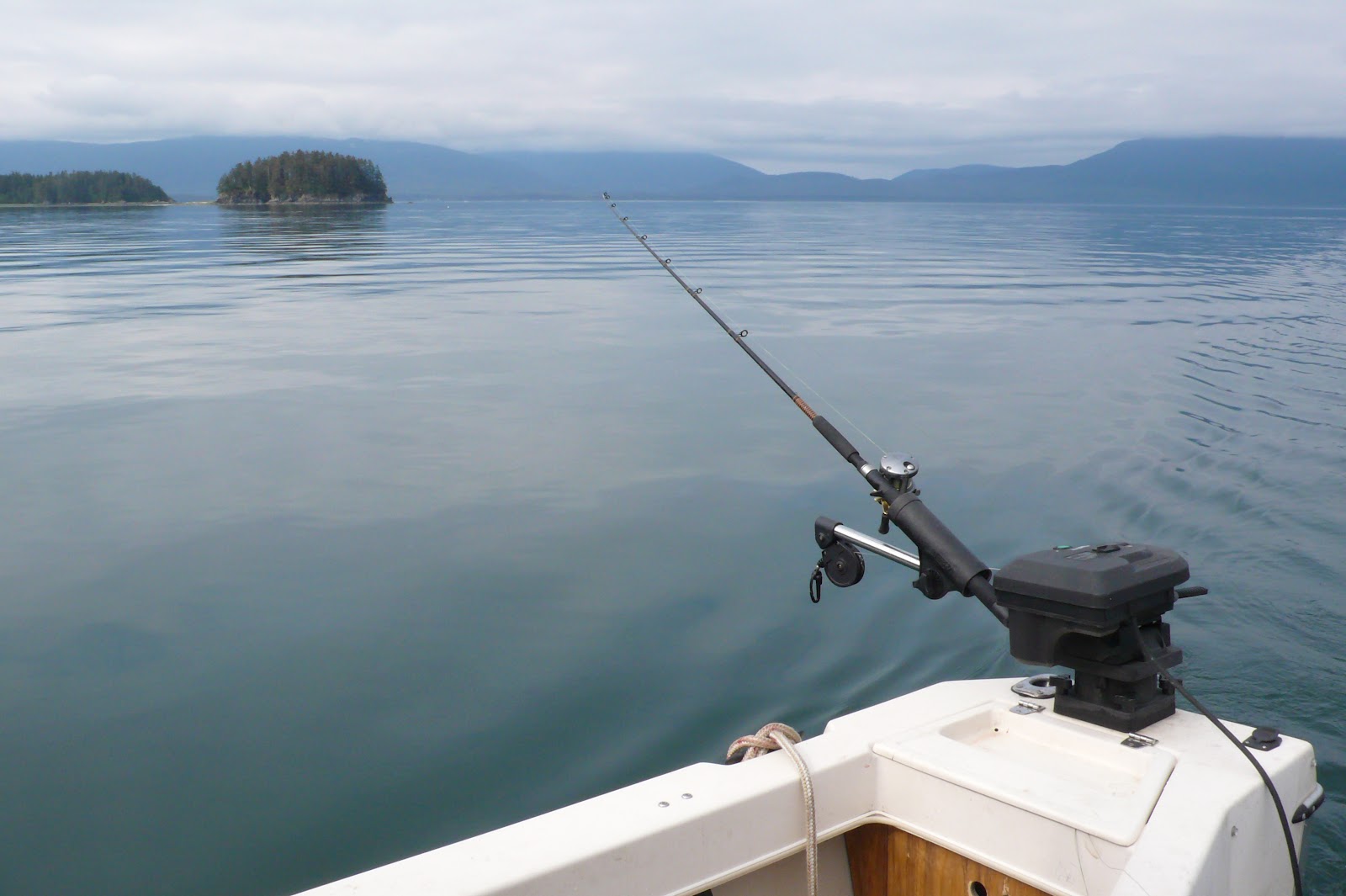

And there is always plenty to look at: varieties of birds, fish, innumerable eagles, seals, sea lions, and often lots of whales. Interesting things float by. It is a day in which moment succeeds moment. 

The wind shifts, and we're in a chilly mist. I am sipping coffee as the tide ebbs. The sky changes and the day evolves. Clouds thicken and briefly a shower drenches us; the sun finds an opening and highlights the snow-capped Chilkat mountains and a distant glacier.

As the overcast dissipates, I warm up and begin to shed layers: raincoat, halibut jacket, wool shirt. I trail my hand in the water, and taste it as it drips from my fingers.

The peace and calm of observing nature and weather is punctuated occasionally by the quiver of a fishing pole, and sometimes that leads to the capture of a nice salmon or halibut. But more often than not, bait is snatched away and something down there has got a free meal on us, or we carefully release an undersized or unwanted fish. 

Or nothing at all happens.

Although not always a lot of it, there's talk. After about twenty-five years of fishing together we've shared a lot of experiences, so at times we retell old fishing stories: long hauls in his small skiff before Brian got the bigger boat; getting caught in bad weather; monster fish that got away; the time we hooked halibut and several species of salmon all in one day. We laugh about the time I got seasick on the brand-new boat and my trip to the ER with a hook in my thumb. The conversations range through many other subjects. Talk flows easily.

There's also the music, always jazz or rock oldies. And food. I habitually bring fat prepared sandwiches from the deli counter of a local store, apples, other snacks, drinks and Snickers bars. It's become a tradition. I only eat them when fishing, but for fishing you've gotta have Snickers. 

Breaking out the food used to be a good luck charm. It seemed that for years, no sooner would we have all the lunch goodies spread out than we would hook something. Inevitably some of the food would end up dropped and trampled on the deck, a casualty of the action. We've continued to try the "get out the sandwiches" ploy when fish aren't biting, even though it hasn't worked in years. Fishermen, like baseball players, are superstitious. Speaking of superstitions, there's my fishing hat, but that's another story.


We don't always connect with fish, but as things went on this recent day, we were watching some "rock jockeys," beach fishermen on North Douglas Island, when suddenly one of the poles started vibrating. It wasn't long before we reeled in a magnificent gift from Mother Nature in the form of a medium-sized King. As I looked into its eye and felt its fat but sleek body I felt truly blessed to be who and where I was and in the company of a good friend. 

I could not have wished then to be any other place nor to be doing anything else on earth. What more could one possibly ask from a day than that?

Every fishing day is different, but each "look around" is also a nostalgic repetition of something that could not be improved upon and that I wouldn't change in any way. Catching fish is not the main point. For a whole list of other reasons, every fishing day is a perfect day.


Friday, June 17, 2011

Living Here: I'm Cool

A few days ago, I walked home across downtown Mérida when the temperature was 37 degrees Celsius, or nearly 100 degrees F.

I noticed when I got home that I had barely broken a sweat. That's very unlike me. What's going on here?

Ever since I began living in this climate I've done a number of different things to stay cool, like wearing a hat, keeping to the shade, and avoiding the streets and strenuous activities during the hottest hours of the day. But that is not always enough. The high temperatures can get to me, and I end up overheated, shirt dripping, and on the borderline of dehydration if I am not careful.

What was the difference the other day? How am I managing to keep cooler in the heat?

I think what has happened is that I am losing what I'll call my "northern gait," for lack of a better term. I'm doing what the locals know to do without thinking about it. I'm slowing down in the heat.

We all know it's a good idea to take it easy when it's hot, but sometimes slowing down is easier said than done. Any day here you can spot northerners, especially tourists from the northern U.S. and Canada, simply by the way they walk: a "purposeful stride," males with arms swinging and sometimes hands closed, gaze directed ahead, bodies inclined slightly forward, and moving right along down the street. It's as if they are hurrying from air-conditioned building to air-conditioned building, which may in fact be what they are accustomed to doing. The truth of the matter is that if they just slowed down, they wouldn't need the AC as much.


Contrast that to many Yucatecans who move a lot more deliberately down the street.

Of course I am generalizing here. There are plenty of slow-moving foreigners, and by the same token quick Yucatecans. However I think that the climate we grew up in can affect the rate at which we naturally move around. Where I grew up in Alaska, for a good part of the year moving quickly has the advantage of keeping you warm. I am sure that if I had grown up in Yucatán my natural rate of moving around would be adapted to the hotter climate here.

Anyhow, it looks as if I have lost my "northern gait" to some extent. Instead of stepping off the curb to pass the phalanxes of slow-moving pedestrians on Mérida's narrow sidewalks, like I used to do, I now fall in and flow with the current. I also stop to chat with friends I meet, or to cool down for a few minutes in one of the many parks or cafes in the downtown area. It's a natural and healthy adaptation to living in the heat.

I still sometimes find myself walking at a quicker "northern" pace and have to tell myself to slow down, but I have to think about this less and less.

I'm slowing down. And I'm cool.

Friday, June 10, 2011

The Rains are Here -- Almost


This was the scene on my street yesterday afternoon. After several hours of humid-smelling breezes, rumbles of thunder and darkening skies, the clouds finally turned loose just a little and we had about an hour of moderate spinkles in my neighborhood. It wasn't really much of a rain by local standards, but it was a start and a hopeful sign that more is on the way.

We haven't had a significant rain in months. Rainy season normally runs from late May or early June until about November. So the rains are a little late. In nearby pueblos and in the outskirts of Mérida people report some recent squalls but in the city and many parts of the region, we haven't had such luck. Right here in centro the few very light afternoon drizzles we have had evaporated as they hit the ground and did little more than make the streets feel like a sauna.

The Wednesday Diario de Yucatán featured an article stating that 40 percent of the country is experiencing the worst drought in 70 years. Things are pretty bad for a lot of folks. A good thing about Yucatán is that most of the peninsula pretty much floats on a huge fresh-water aquifer. Just about anywhere you can drill a well and come up with abundant water. My well here in Mérida, on the coastal slope and fairly near the Gulf of Mexico, is seven meters or about 23 feet deep. The water I pump for my garden and topping off  the pool is cool and crystal clear. We're in the city so I wouldn't drink it, but it is perfectly safe for swimming. If a situation ever arises in which other sources of water fail, I could easily treat my well water and use it for drinking.

So although it is very dry, in Yucatán we're doing better than many other regions.

Although it wasn't a big rain, yesterday's fall was enough to qualify as the season's official first at my house: I always discover a new roof leak during the first significant rain of the season, and yesterday was leak-day around here. I was walking through the bedroom after the shower when a drop hit me in the forehead. A good-sized puddle had formed on the floor.

I went up on the roof and looked at the spot. Sure enough, I found a hairline crack in the waterproof coating I thought I had thoroughly checked about a month ago. Today I climbed back up with a glob of thick roofing tar and a spatula and sealed the crack. 

The work didn't take long, and I was happy to be doing it. The annual roof-leak ritual marks the imminent end of the hot, tedious final weeks of the dry season and the beginning of the rains. It's a sign that we will soon be enjoying lower temperatures, less dust, fresher air, and will witness a rapid, lush greening of gardens, parks, and all of the Yucatán countryside.

Saturday, May 28, 2011

Childhood Dreams


Not long ago, a reader of this blog told me, “I want to be you when I grow up.” This was in response to a post I wrote about an interesting experience I had exploring ruins in a less-visited corner of Yucatán.


My thought after reading this and some other similar remarks was,  "All I really am doing is the kind of stuff I dreamed about doing when I was a kid." I've realized it's not about "growing up." In fact, just the opposite. It's about throwing off the weight of inhibitions and expectations society places upon us as we mature. It's about going back to the sense of fun, discovery and adventure in daily living that we had as kids.


Children live in the moment. Relationships are incredibly important. They don't search fruitlessly for fulfillment in the accumulation of status or possessions. They give little thought to others' opinions about what they are doing. And primarily for these reasons, kids live more intensely and have a lot more fun than adults.


These thoughts returned to me recently. I sat, half dozing, aboard the Alaska State Ferry Fairweather, sailing from Sitka to Juneau, when suddenly the vessel’s horn blew. The weather was calm and the trip uneventful. Thinking that there must be another vessel or an obstacle ahead made me curious, so I got up and walked to a forward window to see what was happening. Another passenger, who’d moved to the window at the same moment, stood briefly by my side. We gazed together into the distance. There was nothing visible. We looked at each other, both shrugged, and went back to our seats.

A few minutes later the other passenger came up to me, smiling. He’d talked to a crew member. “A little girl wanted to blow the ship’s horn, so the captain let her do it,” he explained.

Immediately I remembered an occasion some years back when I was in Skagway, Alaska, shooting footage for a video production aboard a working steam locomotive of the White Pass and Yukon Railroad. After I had finished, impulsively I asked the engineer if I could toot the whistle. He laughed, gestured to the handle, and said, "be my guest." For a moment I again was a kid of five scooting along the floor in a cardboard-box locomotive, wearing a blue-and-white-pinstripe "engineer" hat and hollering "Woooo-oo-WOOOOOOO."

It was a childhood fantasy fulfilled, and probably the experience that first prompted me to think about the virtues of acting less like an adult and more like a kid.

Looking back at the most engaging activities I have been involved with in my life, it occurs to me that many of these are exactly the things I most wanted to do at the age of eight or ten. Unfortunately when we hit our teen years we often get distracted from these childhood passions as social pressure and then school, family responsibilities and having a job further distance us from the things that really toot our horn, so to speak.

I think that we can enjoy life more and find more meaning when we decide stop acting so grown up, and feel freer to live out our dreams. I guess I will never be an astronaut, but I have managed to incorporate several of my other childhood passions into my life. And equally important, I think that the process has helped me recover a little of the childish sense of wonder and adventure that makes even the mundane and everyday seem worthwhile.

Sunday, May 22, 2011

In Stephens' Footsteps: "The well" at Xcooch

The ancient mound at Xcooch
As I wrote in my last post, in the Yucatán there are places where little has changed over the centuries, and there are lost cities still to be rediscovered. On my own quest of rediscovery, I’ve been following in the footsteps of well-known Yucatán explorers John L. Stephens and Frederick Catherwood, real-life Indiana Joneses, who visited the region in 1841.


Stephens wrote that they had heard stories of  "...an ancient poso, or well, of mysterious and marvellous reputation, the fame of which was in everybody's mouth. This well was said to be a vast subterreneous structure, adorned with sculptured figures, an immense table of polished stone and a plaza with columns supporting a vaulted roof, and it was said to have a subterranean road, which led to the village of Maní, twenty-seven miles distant."


"Not a white man in the place had ever entered it, though several had looked in at the mouth, who said that the wind had taken away their breath, and they had not ventured to go in."


After exploring the ruins of Xcooch, Yucatán, accompanied by Mayan guides, the duo turned their attention to the nearby cenote, or “well.” I intermingle my own observations and comments from 2011 with Stephens’ narrative of the trip from his book, Incidents of Travel in Yucatán.


1841: “…we entered a thick grove, in which we dismounted and tied our horses. It was the finest grove we had seen in the country, and within it was a great circular cavity or opening in the earth, twenty or thirty feet deep, with trees and bushes growing out of the bottom and sides, and rising above the level of the plain.”

2011: A beautiful grove of trees still exists here. As Stephens and Catherwood had done 170 years earlier, we employed a local Mayan guide. Abel Gutierrez, from the nearby pueblo of Santa Elena, known as Nohcacab in Stephens' day, led us down a footpath from a nearby dirt road.

1841: “We descended to the bottom. At one corner was a rude natural opening in a great mass of limestone rock, low and narrow, through which rushed constantly a powerful current of wind, agitating the branches and leaves in the area without. This was the mouth of the well, and on our first attempting to enter it the rush of wind was so strong that it made us fall back gasping for breath, confirming the accounts we had heard in Nohcacab.”

“…It was one of the marvels told us of this place, that it was impossible to enter after twelve o’clock.”


2011: We sat down on boulders near the entrance and Abel began to tell us about the wind, which exhales like mildewed, gusty breath from the lungs of the earth. Abel says it is calm in the mornings, but strengthens throughout the day. My assumption is that the effects of convection, temperature and pressure differences and other natural phenomena create the powerful cool air current that blows out of the cave every afternoon and calms at night. Abel could only say that the cave system is huge and has never been fully explored, and no one is sure why air blows so strongly out of the earth in this spot.

Stephens commented that although it was past noon and the wind from the cave mouth blew fiercely, equipped with ropes and torches, they decided to descend into the "well."


1841: "The entrance was about three feet high and four or five wide. It was so low that we were obliged to crawl on our hands and feet, and descended at an angle of about fifteen degrees in a northerly direction. The wind, collecting in the recesses of the cave, rushed through this passage with such force that we could scarcely breathe."

"In the floor of the passage was a single track, worn two or three inches deep by the long-continued treading of feet, and the roof was incrusted with a coat [of soot] from the flaring torches."

2011: At this point I admit that due to the reputation of this cave system for being dangerous, and the fact that the opening was barred with a metal grating, we did not descend into the well. Stephens' narrative is lengthy, so in the interest of brevity I summarize sections from this point.

They descended steeply for a long distance, discovering caves branching in various directions and, instead of a "plaza" with man-made columns and a hand-polished table, they found an equally-fascinating natural formation.

1841: "It was a great vaulted chamber of stone, with a high roof supported by enormous stalactite pillars, which were what the Indians had called the columns, and though entirely different from what we had expected, the effect under the torchlight, and heightened by the wild figures of the Indians, was grand, and almost repaid us for all our trouble."

2011: From here, Stephens' narrative sounds like a descent into hell. They again climbed, again descended, squeezed through dark, tight passages, and lowered themselves through narrow, perpendicular holes, all the while panting and dripping sweat in the stale atmosphere and choking for breath on the smoke of their own torches.

1841: "We decended with some difficulty, and...came out upon a ledge of rock, which ran up on the right to a great height, while on the left was a deep, yawning chasm. A few rude logs were laid along the edge of this chasm, which with a pole for a railing, served as a  bridge, and with the torchlight thrown into the abyss below, made a wild crossing place."

A typical hand-made ladder of the type
probably used by Stephens and Catherwood
2011: As the descent continued they were forced to crawl on hands and knees. The heat grew "insufferable." Stephens realized that if any member of the party had become ill or faint, it would have been impossible for the others to carry him to the surface. They passed through more caverns and dropped down more perpendicular holes. At long last, they came to a rude ladder, which led to a deep basin of cool, black water...but there was a catch.

1841: “…the sight of it was more welcome to us than gold or rubies. We were dripping with sweat, black with smoke, and perishing with thirst. It lay before us in its stony basin, clear and inviting, but it was completely out of reach; the basin was so deep that we could not reach the water with our hands, and we had no vessel of any kind to dip it out with."

2011: Tortured by thirst, the team only managed to dip a few droplets, barely enough water to moisten their lips, by using some ancient pottery shards they found in the cave. They were forced to return arduously to the surface before finding a stagnant puddle of water, with which they quenched their thirst.

Stephens also found that the purported underground tunnel to Maní was blocked by a rockfall in the cave. Interestingly, if you go today to Maní and talk to locals there about their cenote, which is located in the center of that pueblo and has a similar history of being both an important source of water and of fascinating legends, you'll hear a similar story of lengthy underground passages. Yucatán contains the longest documented cave systems in the world. These particular legends of underground highways have yet to be thoroughly investigated.

Despite his disappointment in finding neither an underground "plaza" nor a 27-mile, "subterreaean road" to Maní, Stephens concluded:

1841: “As a mere cave, this was extraordinary; but as a well or watering-place for an ancient city, it was past belief, except for the proofs under our own eyes. Around it were the ruins of a city without any other visible means of supply, and...with the Indians it was a matter of traditonary knowledge."

"And a strong circumstance to induce the belief that it was once used by the inhabitants of a populous city, is the deep track worn in the rock. … It could only have been made by the constant and long-continued tread of thousands. It must have been made by the population of a city."

2011: Our guide Abel confirmed that indeed, according to the oral history of this place, the entire population of Xcooch once obtained all of its water supply, at least during the long dry season, from this deep cenote. I doubt I will ever attempt to explore this place as thoroughly as Stephens did, but I will continue to dream about the marvels deep in the well at Xcooch.

Friday, May 6, 2011

In Stephens' Footsteps: Xcooch

The countryside of Yucatán has a timeless quality. There are people living on land and in houses where their families have lived for generations, even centuries. Although the rate of "progress" has quickened, some things still change slowly here.

As a teenager I obtained a copy of Incidents of Travel in Yucatán, a well-known account of explorations in the Yucatán Peninsula in 1841 by John L. Stephens and the artist Frederick Catherwood. When I first read them, the travels documented in this book seemed no more than colorful adventure tales out of the distant past or adventure films.

It wasn't until I moved to Yucatán much later that I realized people still do hack through the untracked jungle with machetes; there are still lost cities out there waiting to be rediscovered.

In my travels around Yucatán I also found that many of the places visited by Stephens and Catherwood have changed so little in the 170 years since they wove their real-life, archetypal Indiana Jones tales, that I can carry my well-thumbed copy of their original book as a guide. Recently I visited the ancient Mayan city of Xcooch (shk-oh-sch), near Santa Elena, Yucatán, which was explored by Stephens and Catherwood in 1841. Looking around the area one gets the distinct feeling that nothing much has happened during all the years since they walked here.

Here I share Stephen's words, as published in that 1843 edition of Incidents of Travel in Yucatán (which is fortunately in the public domain), interspersed with my own observations made in 2011.

The "narrow path" is now a road.
1841: "Following...by a narrow path just opened, we again found ourselves among ruins, and soon reached the foot of the high mound which towered above the plain..."

2011: Stephens and Catherwood rode for some time from the pueblo of Nohcacab (now Santa Elena) to reach this spot. A couple of weeks ago, we drove out on one of Santa Elena's main streets (probably the same route taken by Stephens) which quickly turned to dirt and passed through a series of fields and then into trees. We parked when the going got a little rough for my car, and continued walking on a dusty path. Suddenly we became aware of a looming white mass ahead.

2011: "The great cerro," or rocky hill, which once was the great pyramid of Xcooch.
1841 engraving of the pyramid from a drawing by Catherwood.

1841: "The great cerro stands alone, the only one that now rises above the plain. The sides are all fallen, though in some places the remains of steps are visible. On the south side, about half way up, there is a large tree, which facilitates the ascent to the top. The height is about eighty or ninety feet."

2011:  The ruins look much the same as they appear in the 1841 drawings by Catherwood, although not surprisingly the structure appears to be more eroded. This is especially noticeable at its peak. Only a few fragments of the steps mentioned by Stephens are visible, and the large tree is long gone, but a series of wooden posts and railings have been set into the east side of the structure to help climbers safely reach the top. We were told by our guide that parts of the area were recently cleared because archaeologists have been making a survey of the site. 

The view to the west from the top of the structure reaches to Uxmal. A fragment of wall, possibly the "corner of a building" mentioned by Stephens, still stands.
1841: "One corner of a building is all that is left; the rest of the top is level and overgrown with grass. The view commanded an immense wooded plain, and, rising above it, toward the southeast the great church of Nohcacab, and on the west the ruined buildings of Uxmal."

2011: A small section of wall that appears to be the corner of a structure still stands on the level top of the ruin. The view remains nearly identical to that which Stephens and Catherwood appreciated 170 years ago. The nearby church of Nohcacab (Santa Elena) and the buildings of distant Uxmal still predominate the wooded landscape. Nothing has been constructed in the intervening years to mar the vista.

1841: "The ground in this neighborhood was open, and there were the remains of several buildings, but all prostrate and in utter ruin."

2011:  Because the vicinity of the pyramid has recently been partially cleared of trees and brush, ruins of a number of structures are visible. Today we probably can see more than Stephens did, because in addition on one side local ejidatarios, (communal land holders) have been clearing the area for planting.

The ruins, such as the one pictured at left, look like nothing more than piles of rock. Close examination, however, reveals that many of the stones have been shaped or carved. The ruins will be harder to spot when regular seasonal rains begin in June, prompting the leafing of trees and growth of rampant summer vegetation.
Our guide, Santa Elena resident Abel Gutierrez, descends.
Stephens did not explore unaccompanied, but always found local Mayan guides to show the way. I don't often use guides, but since this is a remote site not often visited, I hired Abel Gutierrez, a Mayan man from nearby Santa Elena, to show us around. We wouldn't have been able to find the place, and would not have enjoyed the day or learned so much, without his assistance. I'll share more explorations with Abel, in a place where, in the words of Stephens, "not a white man...had ever entered," in my next post, In Stephens' Footsteps: The Well at Xcooch.

Saturday, April 30, 2011

Wanderings: A Quiet Getaway at The Pickled Onion


I am sometimes a bit contrary and often find myself swimming against the tide. During the two weeks' vacation for Semana Santa, a large part of the population of Mérida goes to the coast to escape the heat and relax. The result is that all accessible beaches are jammed with people. Tens of thousands of people. Many of these folks' idea of relaxation conflicts with mine. While many here enjoy the Easter vacation with music, food and liberal quantities of beer, accompanied by large numbers of family and friends, I am much more able to relax and "vacation" some place where it is quiet and uncrowded.

In pursuit if my idea of vacation, this past week I put some distance between myself and the crowds-and-loud-parties beach holiday scene. I chose Santa Elena, located a bit more than an hour from Mérida between Uxmal and Ticul, in the interior of the Yucatán, as the site for a peaceful two-day retreat. I stayed at The Pickled Onion B & B and restaurant. In sync with its un-Yucatecan name, the place is a little bit different.

If you are arriving on the Mérida - Uxmal - Ticul highway, when you get to Santa Elena you need to follow the signs that direct you to Campeche. Just on the outskirts of the pueblo on the Campeche highway, at a tricky three-way intersection, you'll see the giant red onion sculpture that marks the entrance. What you'll find is not fancy, and not plain. It's just right. The modest, slightly-quirky Mayan-style cottages are new, clean, and nicely appointed, with beds and hammocks, fans, fresh linens, and clean, modern bathrooms.
The pool is new and long enough to swim laps in, with a nice view of the gardens, planted with palms, neem, flamboyants, flor de mayo (plumeria), blue agave, maguey, cactus and other native and drought-resistent trees, shrubs and plants. My favorite feature of the pool is the hammock strung above the water under an arbor full of maracuyá vines. It's a great spot to keep cool, and one of the beauties of this place is that there are only three cottages, so you'll rarely have to wait to use it. It's always pretty quiet. If you can't quite manage to stay disconnected from the outside world for a day or so, there is WIFI, although when I was visiting, service was sporadic. [There also is free public WIFI in Santa Elena's plaza.]

The Pickled Onion is the creation of Valerie Pickles, an Englishwoman who lived many years in Canada before moving to Ticul, Yucatán a few years ago to teach English. When the job was over, she didn't want to leave, so she bought this land in nearby Santa Elena and opened her restaurant. Over time, she says, she has gained a great respect for the Mayan people of the area and their way of life. She commented to me that she feels very fortunate to live in the area and have her business here. On the About section of her blog, she writes, "There is a more connectedness to nature, people, a way of life far different from the big city. The word magical has been used so many times with the tourists that pass by the restaurant and stay a few nights."

Expanding: Owner Valerie PIckles supervises work on a new guest house at The Pickled Onion.

The restaurant menu features Mexican and Yucatecan specialties, plus American-style sandwiches, burgers, fries, and delicacies such as berry cheesecake, home-made banana bread and coconut ice cream. It also serves iced and hot espresso drinks, beer and liquor. If your tastes on a hot afternoon run to Cuba Libres or gin and tonic, Valerie can probably whip one up for you. My favorite restaurant offering is the breakfast, which is included in the cost of a room. It includes liberal servings of fresh fruit, plus juice, coffee, banana bread, toast, granola and yogurt. Eggs and other hot breakfast dishes also are available.

The rental cottages idea took hold when restaurant customers began asking where they could spend the night. Now it has become the kind of place where folks sometimes arrive planning to stay one night, and find they like it so much that they decide to stay over a day or two. And there are many reasons to stay. Santa Elena is nestled right in the heart of the Ruta Puuc, known for its numerous archaeological sites including the famous and unforgettable Uxmal, caves, haciendas, and for its many opportunities for contact with traditional Mayan culture. 

Santa Elena's church and plaza. The blue sign announces recently-installed wireless internet.

Santa Elena itself, although not the largest attraction in the area, is worth looking around. This is a very traditional and ancient Mayan town, whose imposing Spanish church looms over the landscape from atop a rocky outcropping. It's worthwhile taking a little time to walk around the centro, where the church, colonial-era buildings, some with Mayan carved stones visible in the facades, interesting locally-crafted sculptures of traditional Yucatecan dancers in the square and the mummy museum are the chief attractions. I tried to see the mummies, found in the church crypt some years ago, but both times I stopped by the museum the attendant was asleep at her desk. It was very hot that afternoon, and I didn't have the heart to awaken her. It's a small pueblo. The mummies have been there for a few hundred years, at least. I decided to visit them another time and headed back to The Pickled Onion for a swim and my own siesta.
The Pickled Onion is a comfortable and convenient, economically-priced base for exploring a fascinating region of Mexico. It's also a restful destination in itself. Valerie and her friendly staff do what they can to help their guests have the experience they are looking for. Valerie can also recommend a reasonably-priced local guide (more about this in a future post or see the website) for those interested in exploring off the beaten path or visiting with a Mayan family.


Monday, April 18, 2011

Nature: The Tree


Near Xcanchakan, Yucatán -- After you've driven about three kilometers on the rough ejido road through rocky, scrubby Yucatán monte and passed by one pyramid, one small planted field and through two cattle gates, the tree comes into view. You walk back to your vehicle after closing the final rusty gate behind you and tying it securely with the frazzled piece of rope that dangles from its bars for that purpose. If you know where to direct your gaze at that moment, you will glimpse the top of the tree's canopy, spreading high above its neighbors.


It's fairly wild country. As you look in the tree's direction, you are likely to glimpse the local vultures and falcons high in the air above. You'd be well advised to keep one eye on the ground, too. A variety of serpents, including boas, rattlers and coral snakes, not to mention tarantulas, scorpions and innumerable thorny plants, make a comfortable living here.

After passing through the second gate on the vantage point of a rocky cerro, the track again descends, but from this spot forward, because of its height the tree is always in view. Now, if you tap the horn, the hacienda's owner, Jonathan Harrington, still half a click away, will probably hear it, and may start walking down his grassy front drive toward the dirt road to greet you. If he walks briskly while at the same time you drive slowly and carefully to avoid splitting open the crankcase on one the many large rocks in the way, you might just meet Jonathan in the vast welcoming shade of the tree, which stands a couple hundred meters directly in front of the columns and arches of his front terrace.


Likely as not, if Jonathan has heard the horn and meets you by the tree, he will direct you to drive under the high arches of its branches and continue on just a bit further, where there is a second driveway, the old worker's entrance, that brings you right up to the side of the house.


This tree is known locally by its Mayan name as pich (pronounced "peach" by English speakers). Scientifically it is called enterolobium cyclocarpum. Commonly it is also known as an elephant ear tree, ear pod tree, monkey ear tree, devil's ear tree, monkeysoap tree or guanacaste.

The English common names come from the shape and properties of the seed pods, which resemble an ear, and whose waxy interior can be used to manufacture a kind of soap. The seeds inside the intact dry pod make a nice rattle, and are also used in a variety of crafts.

The massive size of this tree is impressive. On a recent visit, I paced off the diameter of the circle of shade the tree casts on the ground around midday, and found that it measures approximately 45 meters (about 148 feet). This means that the tree's canopy shades about 1590 square meters or nearly .4 acres of earth. Looking at my photos later and using the diameter measurement for scale, I estimate that the tree rises at least 23 meters (75 feet) into the air. 


In doing a little research, I discovered that this is not a terribly large example of the species, which is known to reach an altitude of 35 meters, or more than 110 feet. This pich, if not a youth, is no more than comfortably middle-aged. I suspect in this region that the biggest obstacle to longevity for these trees is the occasional hurricane. But so far, this tree has managed to weather storms pretty well. Jonathan tells me that an elder in a nearby pueblo, who was about 90 years old, once asked if the tree, remembered from his childhood, was still alive. Apparently this pich was already a looming presence on the hacienda nearly a century ago.

It is hard to appreciate the size of this organism without spending some time hanging out under it. Coming into its shade you first notice the dark and the pleasant coolness. The lower branches, which arch high in the air where they leave the massive trunk, eventually come low enough at their extremes to be touched by a person walking by. The roots, looking like the gray, scaly tails of living dinosaurs, have as they've grown pushed large rocks upward to the surface. 

Interestingly, the tree's doubly-compound leaves, which grow in clusters, are feathery and tiny, but that does not keep them from creating the remarkably dense and cool shade beneath the branches. Many types of organisms, including orchids, epiphytes, and various species of lizards, birds and insects take advantage of the temperate micro-climate of this umbrella.


If you follow this blog you probably are familiar with the legend of La Princesa (part 1, part 2). You might be interested to know that during the period of my investigation and rumination on this story I always envisioned her ghost languishing in the twilight gloom of this very tree. It fits the role perfectly.

The other day I told Jonathan, a serious poet, that I was going to blog about his pich, and jokingly started quoting the famous Joyce Kilmer poem that I had to memorize as a kid in school. At this, Jonathan rolled his eyes. All of the information I have shared above is interesting, but to me the fascination of this tree is something more. The magnificent creation that is this tree is not something that approaches poetry... to me it far surpasses poetry. And so Kilmer, as overused, tired and trite as he may be, is appropriate. Therefore, if you will excuse me (with apologies to Kilmer)...

I think that I shall never see
A poem lovely as a pich.

Jonathan Harrington poses under the massive pich that marks the driveway into Hacienda San Antonio Xpakay.


Monday, April 11, 2011

Friends from the Blogosphere


Blog friends on a Yucatan beach outing

I have been participating in a phenomenon for some time now and it took me a while to realize it.

I've been e-dating.

Well, not really. It would be more correct to say I have been e-socializing.

To backtrack a little, I was invited to many parties and met quite a few expatriate residents of Mérida when I first came here about eight years ago. Although many were nice people, few of my initial acquaintances from those days became long-term friends. The expat population of Mérida is equivalent in size to a very small town. The pool is limited. Finding others with common interests or attitudes is not always easy if you want a relationship that extends beyond discussing the ins and outs of living here and restoring and decorating old houses, which is the topical lingua franca among expats in this area.

Actually, I have never been the type to hang out with a drink in my left hand and a little napkin cradling cheese on a cracker in my right and make easy conversation with strangers. My stock of small talk is not large, so at these events I tend to hug the wall and observe. That's not the best strategy if your purpose is to "meet and mingle." I now have a full social life with Mexican friends and a small handful of foreigners, so quantity of social contacts is not an issue. But I have at times longed for more of the type of friend with whom I have a lot in common, who always knows where I am coming from. That's not easy to find across cultures and languages.

I never considered the internet as a way to make friends (I am not talking about "friends," as in Facebook, here). However through blogging I have discovered a new way to get to know people and develop new friendships.

Steve, whom I met through blogging, has mentioned from time to time visits with people he has met via the world of blogs. Steve has traveled a lot throughout Mexico, and in many places he goes is able to visit with people he has gotten to know first through their blogs. It appears to me that Steve has made many interesting acquaintances, and some real friends, through his years of blogging. It looks as if I am on that same path.

What usually happens is that I start reading a new blog because the author has begun to make comments on An Alaskan in Yucatán. Or, I notice an interesting blog and begin making comments there. Occasionally that begins a dialog, which may lead to emails or other types of communication. Often we focus on a common philosophy or interest, usually having to do with Yucatán or Mexico. Some of my contacts are people who live here, and others are travelers, visitors or dreamers who hope one day to live or visit here.

Following a good blog for a while allows you to learn quite a bit about the author, who may be someone you've never met. If you read and comment back and forth a while, you get a good feeling for shared interests and attitudes. If you finally meet the blogger in person, the need for "getting acquainted" small talk has been dispensed with, and there is usually a lot to talk about.

Some months ago I met face-to-face for the first time a blogger whose point of view I appreciate and with whom I had communicated for the better part of a year. He'd been reading and commenting on my blog for some time as well. In a final email before he came with his wife to Mérida for a seasonal visit, he wrote, "I feel as if I already know you." I felt the same way. And when we sat down for the very first time to talk, the feelings were proven to be correct. We dove into a conversation that rambled as if we were picking up where we'd left off on a previous meeting, and we continue to get together on a regular basis when he is in town. The rest of the time, we keep in touch through our blogs.

If you read this blog you probably are interested in the Yucatán or Mexico. I encourage you to browse through some of my favorite blogs, listed in my blog roll, "Mexico Blogs I Read," to the right of this post. Some are informal and chatty like letters to family, and some are of professional quality or approach the status of literature. All have something interesting to offer. Take a look. Offer a comment. Who knows...you may make new friends.

Powered By Blogger