Sunday, February 27, 2011

A Moment of Joy


It's Sunday. This morning, as I often do on Sundays, I went down to Mérida centro to enjoy a delicious traditional Yucatecan breakfast with a friend, followed by leisurely conversation in a cafe on the Plaza Grande.

On my way home I walked through the plaza, crowded with vendors, food stalls and hordes of tourists and families on a Sunday outing. Suddenly I became aware of loud, rhythmic drumming coming from the vicinity of the cathedral, located on the east side of the square.

A more staid event in front of the Cathedral, on a different day.

Curious, I walked over to see what the ruckus was about. The area in front of La Catedral de San Ildefonso, the oldest cathedral in the Americas, was jammed with families and youths carrying colorful balloons and cheering. A large, varnished wooden cross, supported by a handful of young men, rose in front of the main door of the building. Next to it a priest, sprinkling holy water, was blessing the crowd. There was lots of laughing and cheering amidst the smoke of incense.

The atmosphere was infused with a sense of fun, happiness and joy.

Having been raised in the much more somber atmosphere of Protestant churches up north, and never having seen anything like this before, I was curious and decided to hang around to see what would happen.

The blessing over, the drum corps began to beat a fierce rhythm and the cross was lowered onto the shoulders of a group of bearers. The happy roar increased. Amidst the noise of the drumming, laughter, chanting and the bobbing of hundreds of balloons, the cross was slowly borne into the church. I joined the throng.

This is an immense stone building full of echos. It magnifies sound and resonates like a monstrous speaker. The tattoo of the drums inside was deafening. Beneath blessed statues of the Saints, whistles blew. Passing in front of sacred, serene images of The Virgin, people cheered. Everyone was smiling. The church was full of young people and families all watching as the procession slowly worked up the aisle to the altar. The priest began to speak, but instead of calm, scripted responses or "amens" on the part of the congregation, they erupted in cheers and whistles. The priest smiled broadly at the noise. This began to sound more like the crowd at a hotly-contested football game than a group of faithful at the beginning of a church service:

"Viva Cristo Rey!" [Long live Christ the King!]

"Viva Cristo Rey!"

Despite the cacophony, the atmosphere somehow remained respectful and reverent.

Now, I am not Catholic and not the most devout Christian, but I can appreciate the enthusiasm demonstrated by this group. The overall feeling was one of intense joy and happiness. It was a very Mexican obsevance of faith, and quite different from a regular mass or the serious and quiet forms of worhsip I remember from my childhood days attending churches in the north.

The event seemed to exemplify for me some key aspects of Mexican culture, like the importance of family and children, the true heart of Mexican society. And in a country where several hundred years of oppressive and authoritarian government has not always been kind to the average person, emphasis on celebrating life and enjoying the moment whenever an opportunity presents itself. It was an interlude of intense joy. A moment purely Mexican.

Thursday, February 24, 2011

Language Learning: Live the Language


In my last post, I wrote about how memorable experiences in a new language help us learn and retain the language. I suggested for those learning a new language, such as Spanish for foreigners in Mexico, that they find a teacher whose methods create those kinds of learning experiences.

Of course I am writing from Mexico and talking about Spanish, but all of the following ideas are applicable to learning any language, in just about any environment.

Finding the right kind of teacher is a good first step. Unfortunately, many American and Canadian expats here in Mexico comment that while they dutifully go to classes and study, it's hard to learn Spanish. Some conclude that they are too old or that their memory is no good. There are those who seem to find it difficult to make a satisfying amount progress, eventually give up studying, and limp along with a rudimentary vocabulary and basic phrases.

I think one reason for this is that many treat Spanish as a course, and not as an integral part of their lives. After Spanish class most students return home, where they proceed to watch English-language TV, read English newspapers, books and internet pages, watch English movies, and socialize primarily among other English-speaking people. Many expats in Mexico even go to English-speaking dentists and doctors, and hire English-speaking plumbers, electricians, handymen and household help. [They also often pay a stiff premium for needing these services in English, but that's a topic for another day.]

The best way to learn a new language is to make it part of the daily routine and incorporate it into life in as many ways as possible. Formally studying a language you would like to learn is important. But really learning the language requires that you use it, and use it a lot.

Here are a few suggestions for creating a richer Spanish-learning environment for yourself, no matter where you live and no matter what your learning goals may be.


Set the language preferences for your computer system and most-used applications to Spanish. Since you already understand how these work and probably utilize them almost instinctively, you already have built-in vocabulary support. As you use your computer, you will begin to notice and understand the terminology. The next time you go to an Internet cafe, computer store, or try to explain a problem to a technician in Spanish, you will be surprised how much easier it is to describe what you need or ask questions.

While you are at it, change the operating language of your cell phone and other devices that you regularly use. It's the same idea as with the computer. You can still send messages and communicate in English. Only the prompts and labels will be in Spanish.

Then, find a Spanish-language radio station that plays music you like (there are many streaming online if there are no broadcasts in your area). Listen to it, DJ's and other talk as well as music, every day. You don't have to listen attentively all of the time; just leave it on while you go about your day. Try to sing along. Watch Spanish television, a
telenovela (soap opera) or something with action, even if you don't understand much of what the characters are saying. Rent or go to movies that are in Spanish.

Learning to hear a new language and distinguish phrases, words and chunks of words is a critical part of beginning to understand. As you learn to hear the spoken language, it will cease to sound so "fast," and individual words and phrases will begin to pop out of the blur of sound.

These are just a few proven ideas that speed up the language-learning process and make it easier and more fun. There is a lot more you can do. I'll publish more ideas in future post
s.

Wednesday, February 16, 2011

Language Learning: Making it Memorable


An important part of living in Mexico as a foreigner is being immersed in a Spanish-speaking environment. Many newly-arrived expats I meet in Mérida ask me about how or where they should study Spanish. I decided to write about it, and soon realized that the topic is worth several installments. This is the first of several planned posts about language learning.


fecunidad -- feminine noun (a) (fertilidad) fertility (b) (productividad) productiveness

(from Webster's New World Concise Spanish Dictionary, Second Edition)

I will never, ever forget the Spanish word, fecunidad, which is an equivalent of the word fertility in English. The word is unforgettable because it was tattooed on my brain at the age of sixteen when my prim and proper high school Spanish teacher said the F-word in class.
 

The teacher, Miss Reitsma, was about forty years old and still lived with her parents. Knowing everything, we teenagers were all pretty sure that Miss Reitsma had very little experience in certain aspects of life, if you know what I mean.

One afternoon in Intermediate Spanish dear Miss R tried to point out the latin root of the vocabulary word
fecunidad by comparing it to the very similar fecundity, a synonyn of fertility in English. But poor, innocent Miss Reitsma, pronouncing the syllables separately as she did in English, "Fuh-K-UN-di-ty," didn't seem to understand why the roomful of dirty-minded adolescents broke up laughing before she had finished uttering the second syllable. Miss Reitsma had a brave heart. She tried a couple of times to pronounce fecundity, but only succeeded in provoking louder waves of snorts and giggles.

She failed that day to demonstrate how to decode word meanings by comparing the roots with similar known words. So, Miss Reitsma did as she sometimes did when things were not going well in the classroom. She loudly sighed. She then, as she often did at these junctures, gazed blankly and a bit sadly into the distance outside the classroom window. As the level of animated chatter in the classroom rose, Miss Reitsma, seemingly oblivious, began a little monologue in French (she was a double language major), "Je ne comprends pas..."

The point of the story is that memorable experiences make learning a language easier by helping to form connections that imprint new concepts in the memory. When you're having fun, are surprised or laughing, for instance, it's easy to enjoy the diversion. When an activity is meaningful and engaging, the learning becomes natural and pleasurable. In these situations, the task can seem almost effortless. Anyone who has been involved in a romance in a foreign language will attest to how rapidly they learned to communicate with their lover. In fact, they will tell you that, even decades later, many important words and phrases from that learning are still easy to recall.

When we were small our parents didn't "teach" us language. We soaked it up by observing and participating in life, nursing, eating, having our clothes or diapers changed and playing with family and caregivers. Although as adult language learners it helps us to have a knowlegeable person explain and clarify grammar, structural elements and provide context for vocabulary and cultural knowlege, we still learn more effectively and better retain the knowledge if it is gained while involved in engaging activity.

How can you have these sorts of language-learning experiences?

Well, Miss Reitsma didn't set about to create a memorable situation that day when she brought the house down. It was just an accident. However these days there are many language teachers who try to make language learning interesting and memorable.

If you are shopping for a language class, it's important to find one of these teachers. Find someone who tries to create interesting situations. Look for a teacher who creates ways for you to actively participate in your learning as opposed to the traditional, didactic approach that consists of lots of time with an instructor standing in front of a room explaining, drilling, then having students memorize quantities of rules and words as homework. The didactic approach is still widely used in Mexican schools, so you will find teachers who use traditional methods. Look for a course or instructor who takes a balanced approach, with an emphasis on active student involvement. You'll need structure and will want explanations, but you also want the material to be of interest, readily applicable in your life and presented in an engaging manner.


It is possible to become proficient in another language, and although you have to invest some effort, it doesn't have to be a grind. I'll share more experiences in my next post.

Wednesday, February 9, 2011

Nature: Fertility


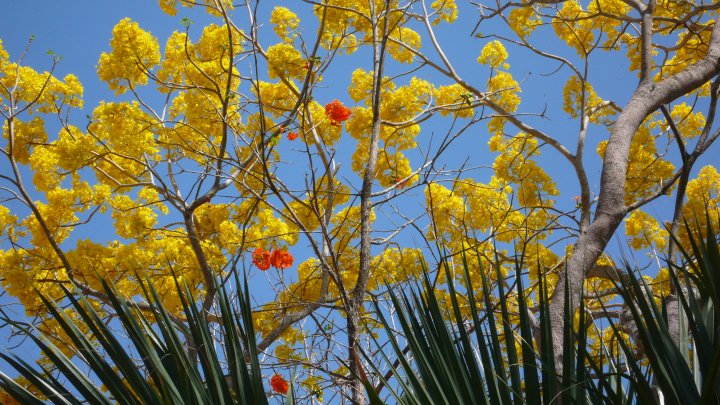
It's a cold and snowy winter up north. That makes it the dry season in Yucatán, and although the countryside can be brown and dusty, commonly we see flowers, particularly flowering trees, in bloom right now. Many of these trees have lost their leaves, making the colors really stand out. It's a pleasure in this parched season to come upon such an unexpected burst of color.

Of course there is a reason. In a few months, following the dry and hot spring, suddenly Yucatán will be blessed with abundant daily rains. The riot of flowering now means there will be lots of seeds, ripe and ready to sprout, when moister weather conditions give them a better chance to mature. 


In places like the home gardens around Mérida, where many of us water and care for our plants through the winter drought, this can be a season of particular richness.

The bloom at right is a good example. A couple of years ago my neighbor Gilda gave me a couple of sprigs from her "copa de oro," cup of gold plant. On her direction I stuck them in the ground and after that did little but water them occasionally. Last summer, after growing very slowly and apparently investing energy in putting down roots, the copa de oro poured on a burst of speed. The stems are now about four meters, at least twelve feet high, and have begun to flower. This blossom fell to the ground the other day.

The nopal cactus is flowering like crazy, attracting hummingbirds and leaving hundreds of knobby fruits to redden as they mature. If not picked and eaten, the tunas will drop, leaving thousands of seeds in the soil to sprout later in the year. Nopal also regenerates from cuttings. Any piece of nopal that falls to the ground will quickly put down roots and grow.


I am still eating bananas from bunches that matured in January. Even though the birds and zorros, or opossums, got their share, I have eaten my fill of bananas and given lots away. This is the last of the second bunch, stored on the cool floor of the interior patio where they are safe from the animals. These are the best bananas I have ever tasted. I suppose that's because I'm still accustomed to the flavor of store-bought bananas that were picked green. These ripened on the plant. There is an amazing difference.

Way at the back of the patio, the bugambilia and thumbergia have intertwined and rioted so far out of control that I suspect a major intervention will be necessary to re-establish my possession of the corner. I haven't had the heart yet, since they look so great with their lavender and hot pink flowers mixed. I'll cut them back before the rains start in June. Meanwhile I'll cede temporary title to the back corner to these rowdy plants in exchange for the beautiful vista.

Also in back, not far from the occupied corner, the naranja agria, sour orange, tree is in bloom, dropping its white petals to float on the surface of the pool. This used to annoy me a bit because the petals are tiny and cost me some work to clean up, but I have come now to appreciate their snowy froth on the water in the morning. The aroma of orange blossoms gives the pool area a wonderful atmosphere. Next fall the oranges will go into a variety of Yucatecan recipes and make refreshing drinks.


There are many, many other native and introduced plants that blossom at this time. One of the locals, a
hennequen plant in my patio, pushed up its baseball-bat-thick spike and commenced to produce about thirty large bunches of pale flowers a couple of months ago. After flowering the plant produces hundreds of tiny, fully-formed plantlets, which fall to the ground to find soil in which they can grow. The mother plant will now die, hopefully leaving many progeny to replace it. I will gather some and root them in containers, for later planting when I have room.

Meanwhile we continue to enjoy cool, flower-scented nights in Yucatán. But not for long. Before the rainy season comes we must endure the worst of the year's heat. The temperatures are rising, and will peak out in May. At some point in late May or June regular rains will cool things a little and saturate the soils. That is when a lot of the seeds that right now are being produced will begin to germinate and plant growth will accelerate dramatically.

Wednesday, February 2, 2011

Wanderings: Beyond Chichén Itzá -- Ek Balam


Take a good look at that set of steps. The pyramid above is larger than the famous pile at Chichén Itzá, named last year in a marketing-inspired competition as one of the New Seven Wonders of the World. This amazing structure is much less popular than the one at Chichén. In fact unless you live in Yucatán or have made a point when visiting to seek out less-famous archaeological sites, it's likely you've never heard of it.


This is Ek Balam, which means Black Jaguar in the Mayan language, located about twenty minutes' drive from Valladolid, Yucatán, or a couple of hours from either Cancún or Mérida. It's as accessible as Chichén Itzá.

A number of years ago, when I first visited Yucatán, I made my obligatory pilgrimage to Chichén, the signature Pre-hispanic site of Yucatán. It was impressive. My friend and I meandered among the hundreds of columns, strolled through the ballcourt and wondered at the cenote. We wandered in and out of buildings, climbed the pyramid, and admired the far-reaching view. We arrived early, just as the site was opening, and by the time we had explored for a couple of hours the tour buses from Cancún were roaring in at an increasing pace. The June heat was rising quickly and the place began to get crowded, so figuring we'd seen enough for a first visit and wanting to avoid the crush, we left.

I have yet to make a return visit. Why?

Well, as my friend Paul recently wrote, Chichén Itzá has become a victim of its own success. It has become so popular that, in order to protect the site from the hordes of tourists who daily descend upon the ancient city, officials have had to prohibit many of the activities that once enhanced the experience. You may no longer climb the pyramid, enter buildings or walk among the columns. Due to the crowds, it is no longer easy to quietly contemplate the genius of the ancient Mayan planners and architects who built this city. And running the guantlet of souvenir vendors does not add to the experience.


The other reason I haven't gotten back to Chichén Itzá is that there is a great number of other sites to visit. Ek Balam is one of many fascinating alternative archaeological sites in Yucatán. Not only does it boast structures larger than the pyramid at Chichén Itzá (according to one guide I read), you can climb right up, hang around on top and appreciate the expansive views. You can walk through ancient doorways and imagine what life here may have been like before the arrival of the Spaniards. You can bird-watch and appreciate orchids growing in the trees. And you can relax, because since the tour-bus crowds have never trampled the place the guards are mellow, few areas are roped off, and it's quiet. It's like Chichén Itzá was years ago.

I don't mean to mislead you...
Ek Balam has not been rebuilt to the extent of Chichén. It contains at least 45 structures, roads, is surrounded by stone walls, and covers 12 square kilometers, but is mostly in ruins and covered by undergrowth. Only one facade of the large pyramid is restored, but there are heiroglyphs, beautiful sculptures and other monuments. Several buildings have been rebuilt, but much of the site is still covered in trees and vegetation. You have to look more carefully. You have to walk on dusty trails. To me, this is part of the attraction.


There is also a beautiful cenote on the grounds, suitable for swimming and snorkeling. The cenote is owned by the local ejido, and you've got to pay additional fees to enter. I didn't go this time, but I am told it's worthwhile.


It is certain that under-visited treasures like Ek Balam will become more popular as time passes. As if to make the point, when I was coming down from the pyramid or "Acropolis" of Ek Balam, several van-loads of day trippers from Cancún approached with their guide, and some began to climb. One of the young women stopped short and stared up at the height of the structure. Fashionably turned out in heels, revealing tropical mini-skirt, bikini top and jewelry, she was dressed more appropriately for being "seen" at a resort poolside lunch than climbing ruins. I do believe her jaw dropped for a second as she took in the massive stairway in front of her. But she quickly returned her attention to the Blackberry in hand and while eyeing text messages, commented, "There's no elevator?"


This is the sort of package-tourist that has made Chichen Itza what it is today.


So I suppose that with tourism growing and the Yucatán state government's frequent promises of new projects to "detonate" tourism growth in the area (for reasons I can't fathom, they always say "detonate"), it is inevitable that sites like Ek Balam will receive more visitors in the future. Let's hope that as visits in the region increase, these wonderful places can be developed in sensitive ways that permit them to retain some of their innocent, underdeveloped qualities.


I guess it's a good idea to spread the visitors around, rather than have a small number of famous sites, places like Chichén Itzá, suffer most of the impact. This also would more evenly distribute the economic benefits of new jobs. 


The good news is that there are many fantastic places like Ek Balam in the Yucatán. I plan to write about more of these in future posts.


Wednesday, January 26, 2011

Wanderings: The Pleasures of a Neighborhood


Valladolid, Yucatán -- Once a long time ago, I took a tour. We spent a lot of time looking at sites of interest through the windows of a bus. The bus occasionally stopped so we could briefly descend with a guide, who walked ahead holding an umbrella high in the air, explaining things to us and making sure the group stayed together.


It was not a bad tour, I suppose, but in short order I realized that being a traditional "tourist" was not for me. I've seen a pretty good sampling of countries and cultures in the years since that experience, and I have tried to do my traveling in more discreet, organic ways that permit me to come closer to feeling the real textures and rhythms of a place. I want to see life and nature, not "attractions," which generally are cooked up by marketers especially for visitors and have little to do with reality. I want to feel history and observe culture, which is not easy when most everyone around me is more intent upon posting vacation poses to Facebook than in having an experience, and the locals I meet are only friendly if they think I will buy something.

Rather than gain superficial impressions of a wide area, I prefer to get to know a small geographical area in depth. One of my favorite ways to enjoy visiting a place is to immerse myself in a neighborhood and if possible stay awhile. It's a good way to get a sense of place, absorb the atmosphere and get to meet residents, who are much more informative and fascinating than any tour guide. I have done this in a number of cities over the years and find I can return again and again, and always feel at home in "my" neighborhood.

Habitually I adopt a cafe or restaurant, and once I have been in a few times, the staff recognize me. If the waiters are good and it's a real cafe, after a few days they bring my cafe americano -- black, no sugar -- without even having to ask (talk about feeling at home!). On the street, once they realize I'm not just a day-tripper who will be on the road the same afternoon, residents take the time to say hello. Soon I know streets, routines, bus stops, and where to find things. I begin to feel connected to the place. Then when I feel ready I can branch out and take day trips from my base area, returning to the comforts of the neighborhood at the end of the day.

In Valladolid, I have done just that. I discovered the neighborhood of
La Candelaria, a historic area about three blocks from the main plaza.


La Candelaria meets all my criteria for a good neighborhood. It's within easy walking distance to centro and transportation. On tranquil Parque La Candelaria itself there is a good Italian restaurant, cafe, ice cream shop, a hostel, church, library and theater nestled amongst family homes, shaded benches and flowers. Within a couple-blocks radius it is possible to find just about anything else you might need.

There is activity in the park, but it never seems to get crowded or noisy. In the morning you can see men on bicycles and women dressed in traditional huipiles going to work and doing the daily marketing. People meet here to talk and pass the time of day. At night families come to the park to talk, walk their dogs, and play with their children.

On my first visit to Valladolid a few years ago I stayed in a large hotel on the main plaza. The visit was fine, but after seeing the cathedral, looking around downtown and visiting cenote Zací, I left, not feeling any particular interest in returning. After my immersion in
La Candelaria, I look forward to future visits.


If you are interested in visiting Valladolid and staying in La Candelaria, I highly recommend this hotel, which charges under $40 US for a very clean and pleasant double, and is located on the corner of Calle 35 and Calle 42. That's a half block, on a pedestrian-only street, from Parque La Candelaria. If you are on a tighter budget, Hostel La Candelaria is located right on the park, located at the intersection of Calle 35 and Calle 44. 


UPDATE, Feb. 2012: The hotel appears to have changed ownership and prices have risen a bit, but it's still a good deal. Here is a new link.

Sunday, January 9, 2011

Living Here: Cold


May, 1994: I was working on a project on the floating ice of the Chukchi Sea, north of Barrow, Alaska, where the temperature was well below zero. My recollection of this "siesta" lying atop a snow machine amidst ice and snow is a memory of feeling quite warm, hot actually. I was resting for a few moments in order to cool down.

December, 2010: I awoke chilled enough some mornings in my Mérida bedroom that I didn't want to get out from beneath the blanket. My nose, sticking out above the covers, felt cold. I knew that when I put my feet down on the hard tile floor it would feel very cold. One of these mornings when I finally got up and checked the thermometer in the patio right outside my bedroom, the temperature was 19 degrees Celsius, or about 66 F.

How is it that a person who grew up in cold climates finds himself chilly at a temperature which a few years in the past may have had him running around barefoot and in shorts? I suppose it has to do with the amazing adaptability of human beings, what we are accustomed to and what we expect.

It's interesting to walk in Mérida centro on a cool evening, comfortably dressed in short sleeves, and notice that many others are wearing sweaters and jackets, with scarves (bufandas, one of my favorite words in Spanish) tightly wrapped around their necks or even over their noses and mouths.

Often a frente frío, cold front, rates big play in the local newspapers, which feature photos of Yucatecans bundled up to face the winter chill. Here is an image of two front-page headlines from Mérida's Diario de Yucatán a couple of weeks ago. The lower headline warns the public, "The cold will be 12C (54F) today."

As I was walking one fresh morning recently I noticed a street sweeper at work along Calle 59, wearing gloves, long pants, and a long-sleeved sweatshirt with hood pulled up over the top of his baseball cap so only his visor and face were exposed. I was moving at an easy pace on the shady side of the street, but not slow enough to keep from getting a little damp under my short-sleeved cotton polo shirt. This guy was exercising hard with his big broom, and appeared to be quite comfortable all bundled up. It's amazing to me that two people can feel and react so differently to the same weather circumstances.

Due to the cold, some schools here in December gave students permission to arrive a half-hour late for morning classes. The early morning temperature was in the range of 10 - 13 degrees Celsius, or about 50 - 55 F. A friend of mine who teaches in an elementary school in Mérida tells me that absenteeism is very high on these days.

Meanwhile, my friend and former neighbor Sally Donaldson posted this picture on her Facebook page, showing the view from my old neighborhood in Juneau. This was a "warm" winter day I think, with the temperature hovering just around freezing, lots of moisture in the air and snow or freezing rain possible at any moment.

Normally when the weather is like this in Juneau, we hope for a stretch of clear days. Then the sun shines and without an insulating layer of low clouds the temperature drops. The roads and walks remain free of ice and snow. The result is that driving and outdoor activities are more pleasant, so people go outdoors to hike, ski and play. That is quite a contrast to scenes of Yucatecans "freezing" amongst the flowers and palm trees at much warmer temperatures.

Why the contrast? It has a lot to do with what we are used to. For those who have always lived in a climate where most of the year their bodies are wrapped in a sweaty envelope of intense heat and high humidity (read earlier post here), a front of cooler, dry air can seem very cold. And there is a psychological element as well. It's winter. It's chilly. Brrrrrrr! Must be time to bundle up.

I am not belittling peoples' reactions to the cold here. There are areas of Yucatán where the winter temperatures sometimes reach almost to freezing. Homes are designed for a hot climate, not cold. The same qualities that make homes comfortable most of the year (airflow, open space, high ceilings) make them drafty and chilly in winter weather. And virtually no homes in Yucatán have heat. Many do not have hot water.

In addition, families of limited means simply don't have the money to devote to sweaters, jackets and blankets, especially with a cool season that is relatively short. Many are doing well if they keep food on the table, keep the lights burning and can provide their children with adequate shoes and clothing. Buying winter clothing is just not feasible.

Personally, although I sometimes marvel at how I have adapted to the Yucatecan heat, the cool weather of December and January doesn't bother me. But I don't swim from November until about March. When visitors from the north show up, they want to jump in the pool or go to the beach. I hang out with them, but generally I don't go in. Although in Alaska I swam in water cold enough to have ice floating in it without feeling particularly distressed, here the unheated pool or ocean in winter feels uncomfortable. And I do find myself grabbing a sweater at times when the temperature is not really what we would consider "sweater weather" up north. I have gotten to the point where I do as the locals do, I guess.

Interestingly, when I travel north into winter weather, I feel fine. It seems I have expanded my comfort range rather than shifted it, but a chilly winter morning still seems a lot colder in Yucatán than in Alaska. Of course how we deal with weather has a lot to do with experience, having appropriate clothing and a variety of other factors. However, I have begun to think that psychology and our expectations have a lot more to do with how we react to weather than we normally give credit for.

Thursday, December 23, 2010

Year's End: Appreciation


It's been a busy year and not the most enjoyable, due to a series of family medical crises. I found myself coming and going frequently, and forced to deal at length with some of the very aspects of life back in the U.S. that I moved to Yucatán specifically to avoid. It was exhausting in all senses of the word.

On the surface it was not the best year of my life, but I think that because of the difficulties it has been a year of great personal growth. In mid-November, arriving back from my latest trip north and with most of our family concerns dealt with for now, I looked forward to getting back into a normal routine. What I felt upon arriving home, though, was that every movement seemed difficult, as though my limbs were encased in hardening concrete, every thought cloudy, fogged. I decided to give myself a break, and for a while not to attempt anything I didn't want to do. I haven't gone out a lot, haven't published much on this blog, and the house could use an energetic cleaning.

What I found myself doing these past weeks was enjoying the birds and plants in the back yard, lying on the roof at night to watch the stars, reading, taking more time to talk with my neighbors, and hanging out with my closest friends. I also had plenty of time to sip coffee and think.

What did I think about?

I appreciate my family. We are a lot closer now. We pulled together to manage a difficult situation and I don't think we let the stress hurt our relationships.

I appreciate my friends. It's an old saying that you find out who your friends are when you most need them. How true. Real friendships are rare, and I feel privileged to have a number. Friends like Victor, who took care of the house, paid my bills, and always has time and the interest to listen when I need someone to talk to. Friends like my neighbor Margarita, with whom I have not always seen eye-to-eye, but who insisted upon dropping me off and picking me up at the Mérida end as I made twelve trips through airports this year. Friends like Paul, who let me take breaks on his houseboat when I was in Seattle for two months while my mother underwent exams and then the daily grind of radiation therapy. And quite a few other great friends who accept me just as I am and who really care about people.

I appreciate lessons learned from the sick and the old, the dying and the dead. I wrote about two of these people (Alberto and Alejandro) earlier this year. I spent a lot of 2010 in hospitals and nursing homes, around people suffering from a variety of serious illnesses and who lost loved ones. Witnessing as they managed their lives, interacted with their families and got on with living in spite of everything is inspiring and makes me grateful for all I have. They remind me that the only things that make for true happiness (assuming one has the basic necessities of diet, shelter and health) are the wonders of faith and the spirit, the beauties of nature and human creativity, and the love of friends and family. These are the main things that really matter when it comes to happiness. The rest, a huge proportion of the economy that people worship, "need" and worry about, is just stuff that gets in the way.

I appreciate the peace and civility of the Yucatán. It's not perfect and once in awhile, even after many years here, I still feel like a fish out of water, but it's a supremely secure, friendly and wonderful place to live.

Thinking about all this has helped me to plan for the future and hopefully be prepared to accept gracefully what's to come.

Merry Christmas and Happy New Year.


Photos:
Top, a yellow and red poinsettia, known in Mexico as nochebuena. Above, Joseph and the Baby Jesus, by the Yucatecan painter Alberto Castillo Ku, 1920 - 2010.

Friday, December 3, 2010

Living Here: Flojera


I haven't posted anything in this blog for two weeks, and although I have probably fifteen ideas for posts in draft, I can't seem to get one finished. I don't seem to be getting much of anything else done, either, and I don't really care very much.

I think I am suffering from flojera, lethargy. In Mexico, if a person is flojo, that means they are lazy, a layabout. I don't know how common the expression is, and it's not in the dictionary, but I know a couple of people in Mérida who term this condition flojeritis. Lack of energy and interest in work or accomplishment are the primary symptoms of this complaint.

In my case the flojeritis aguda (the acute form of the disease) probably stems from several causes. Three weeks ago I came down with some kind of bug that bothered my stomach and made me tired, and it has persisted for quite awhile.

About that same time I also started having fairly serious problems with my aging laptop that make handling photos and working on the blog extremely tedious and not much fun.

Then along with the longer fall nights we've been having cool mornings. In an airy old stone house like mine, on these mornings it feels really good to pull the blanket over your head and stay in bed a bit later.

And looking back, I took seven fairly major trips in the past year, some of them pretty stressful.

All legitimate reasons to feel a bit flojo. I think my mind and body are just telling me I need a good break.

I don't suffer from flojera too often, because I have enough interesting things to do around here that even on a bad morning I always manage to get up long enough to get started on something. Once up, it doesn't take me long to get involved and forget that I didn't feel very energetic at the outset. Or sometimes, when I feel the symptoms of flojeritis coming on, I just take it easy for a couple of days, stay in and finish reading a book, and let the bug take its course. Then after a bit I find that I want to be outside, and again have the energy to do what I need or want to do.

So I know flojera is just temporary. I've been to the doctor and my stomach is better. I have more energy. I visited the corner hardware and bought a badly-needed new broom and a few household repair items, and for some reason that makes me feel like doing chores around the house. And here I am, almost finished with a post for the blog.

I'm pulling out of it. Think I'll post this and go take on the leaf-strewn patio.

Powered By Blogger