Saturday, February 25, 2012

From Silly to Sublime


I've never posted about Mérida's Carnaval, this year's rendition of which ended last Tuesday. I guess that's because it's been covered many times, and also because I like to post good photos, which can be hard to get from behind a huge crowd, which is generally the position from which I've observed the parades in the past. And after a few years of participating fairly heavily in the activities, I cut back on my personal involvement in Carnaval. It's fun, it's an important part of the culture here, and I enjoy it, but now I appreciate it in smaller doses. I've gotten to the point where a solid week of daily parades, loud music and partying is more than I care to experience.

The parade route passes only a few blocks from my house. Even when I stay home, the noise and congestion are evident. So after attending one parade at the beginning of the festivities, I decided to leave the rumble and blast of Carnaval behind, and cut out for an overnight stay at the beach in search of a little peace and quiet. The contrast hardly could have been greater.


Upon arriving at one of my favorite beaches, I was immediately caressed by a perfume quite different from the normal salt-air aroma we always expect along the Gulf of Mexico. The stark, white sand beach smelled like a flower shop. And the source was not readily apparent, although I finally tracked it down to this fringe of tiny white flowers in full bloom right above the high-tide line. The lime-green of the foliage created a brilliant contrast against the sand in the glare of the sun.


I'd borrowed keys to an empty beach house, so the next morning, after a restful sleep in a hammock hung there, I headed out early to the nearby estuary. In this season the mangroves and brackish shallows here are home a great variety of migratory and indigenous birds. I climbed a palapa-roofed observation platform that permitted me to watch a distant grouping of feeding flamingoes, along with many species of ducks, egrets, herons, cormorants and pelicans.

Every so often a flock of flamingoes would pass over, yacking incessantly as they headed away from the sunrise in search of feeding areas. As each flock passed over, one or two pairs would suddenly wheel away from the group, and make a spiraling descent in order to join their fellows already wading and dipping their hooked bills in search of breakfast. The feeding assemblage of hot pink birds slowly grew as more and more joined in.

Ducks, congregating in large, tight clusters to repeatedly dive and surface in the shallows, created boiling disturbances on the black water as they pursued feed in the depths. Occasionally a large number would startle and take flight together, calling and creating a wet rushing sound as they flapped and surface-stepped briefly in order to gain sufficient speed to become airborne.

When I returned to Mérida on Tuesday, the party was still on.


There were the beer floats, with twelve-foot-high bottles of Sol and bikini-clad girls shaking for all they're worth to high-volume music. A float sponsored by a bottled-water company sprayed a fine mist of water on the sweltering crowd. Bands of drummers pounded away and the bass beat vibrated our insides. Fanciful, tall creatures walked by on high stilts. Thousands of costumed revelers entertained an estimated 800,000 persons along the parade route.

My view of the final Carnaval parade this year was somewhat different than usual. My friend Paul offered me a place in his palco, or box of eight seats, along Calle 60. This afforded a shaded, front-row view of the party.

Sitting in a front-row palco offers a lot of advantages. The view is fantastic. You can see everything, and many participants in the slow-moving parade love to interact with the crowd, so it's possible to talk with them, shake hands, and get them to pose for pictures.

Then there is the food. Carnaval sponsors toss out lots of treats, mostly snacks, trinkets and T-shirts. When you are standing in back of the throng, there's lots of competition, but from the relatively comfortable folding chairs of a palco, it's possible to catch them without a scuffle. There was plenty, and we shared with our neighbors. I ate a cheeseburger (snatched out of the air and handed to me by Paul, who's not eating much meat these days), a variety of cookies and candy, and drank a Coke. Not exactly health food, but it was all part of the party.


So it was a good Carnaval for me. I enjoyed it more than I have in the past couple of years.

Lesson one: Spending part of Carnaval week in a serene place away from the hullabaloo allowed me to appreciate the craziness more when I was back in it.

Lesson two: Have a good friend who offers palco seats to you. Or reserve a palco yourself (and be that friend to others).


Friday, February 17, 2012

Living Here: The Art of the Siesta

Some people are very casual about their siesta

I think that taking a good siesta is an art.

The traditional afternoon siesta developed for good reasons. Napping is a great way to escape the worst heat of the day and refresh one's self for the evening ahead.

Some people, like the guy pictured above, just casually plop down for a little rest in the afternoon. That's great and it works, but I think a siesta can be something more. There's a technique to having a really good siesta.

First, you don't want to sleep too long, or you wake sleep-drunk and spend too much time recovering your energy and focus. And there's nothing wonderful about waking up at dinnertime and realizing that you've accidentally slept a whole beautiful afternoon away.

However when the siesta is too short, I find it unsatisfying. I don't simply lay down. I make it special, and here are a few of my guidelines.

Although it's tempting, don't take a rest immediately after lunch. Stay up and get a little exercise first. It's better for your digestion. You'll rest easier.

Take off your clothes. Especially if the weather is warm, this is a good idea. It's more comfortable, and your clothes will feel fresher when you put them on again.

If daytime sounds bother you, create white noise. Soft music or a fan are good for this. Silence the phones to ensure quality time. If you are serious about your siesta, you've got to make sure there are no interruptions.

Try taking your siesta in a hammock or another place different from where you sleep at night. I think this signals mind and body that it's just a siesta, not a full overnight sleep and makes it easier to get up.

My favorite place for a siesta...an empty beach house
Unless you are good at cat napping, set an alarm, and get up when it goes off. For me, 30 - 60 minutes is the perfect length for a siesta. However if you wake up after 20 minutes and feel good, go ahead and get up.

Jumping in a pool or having a cool rinse-off in the shower after a siesta really helps get the afternoon off to a good start. If you like caffeine, have a cup of coffee or tea. I like to drink my cup of hot coffee in the pool. On afternoons when I am having a hard time getting up, the dangling carrot of a cup my of favorite beverage in the cooling water helps get me vertical.

I find that the sleep of siestas is often deep, dreamless and less restless than at night. Taking a good siesta doesn't necessarily help me stay up later at night, but the quality of my evening improves when I have rested.

That's what works for me. Of course, here I am talking about siestas taken alone. The art of the siesta -- accompanied -- can be something altogether different. I am not sure I am prepared to write about that, in this blog, at least. But you'll know it if I do.

Saturday, February 11, 2012

Contentment: Surprises and Small Pleasures

Photo by Eric Chaffee

Thursday my friends Eric, Paul and I decided to take a drive out to the coast and visit a favorite beach area not far from Mérida.

It was an uneventful but, as always, interesting drive. As we meandered through small pueblos where motorcycles, bicycles and pedestrians vastly outnumber the cars, we slowed to eyeball roadside fruit stands, searching for hard-to-find tropical varieties that are uncommon and costlier in the city. Passing through stretches of countryside between pueblos we watched the changing scenery and identified a couple of rustic side roads that looked interesting enough to draw us back on some future exploration.

Soon we sensed the rich, organic aroma of the sticky black mud in the brackish lagoon. Suddenly on both sides of the road there was water, shallow, dark and dotted with clumps of mangroves, snags and the forms of various wading birds.

We were nearing the coast but still surrounded by the lagoon when we saw it: a scattering of dark specks against the blue sky, as if a giant had hurled a huge handful of black pepper into the blue. Eric stopped the car in the road and we jumped out to look.

The specks took shape, forming into straggling, irregular lines as they neared us. As they grew in size, the dots suddenly transformed into silhouettes revealing shades of hot pink in the morning sun.

We were watching a flock of flamingos, which had been flying along the coast and suddenly veered inland above us, making toward the lagoon we had just crossed.

Photo by Eric Chaffee

This flock passed over, and as it did so, another appeared in the distance, rising over the palms. This wave, too, took form and color and passed gracefully overhead. While it was still in view, yet another appeared. Then another, and another, each cluster connected to the preceding by a thin single file of birds. From looking at some of Eric's photos afterward I estimated that each wave consisted of between one hundred and two hundred birds. We saw at least seven or eight separate groups, which leads me to conclude that over a period of perhaps ten or fifteen minutes, we saw probably between one and two thousand flamingos.


The high point of the day had come early, but the rest of it was not a letdown. After spending an hour or two wandering and observing in a nearby nature reserve, a virgin coastal strip which includes beach and lagoon (and according to warning signs, is home to crocodiles), we came back to the pueblo to wander through the centro and go to a favorite seafood restaurant.

The waiter always remembers us and greets us with a smile and a handshake. As usual, the ceviche and fish filets were superb.

The sound system played Louis Armstrong singing, "On the Sunny Side of the Street." Palms and flowering trees swayed in the gentle, mild breeze. I savored my coffee as we sat under the palapa and talked the afternoon away.

Finally, we walked a meandering route back to the car, through a neighborhood inhabited by fishermen, along the beach, and out onto the pier, where we proceeded hats-in-hand, due to the strong breeze. We talked with two boys selling jewelry and utensils made of shells.

As frequently occurs around here, a day begun without a specific goal turned out to be one of surprises and small pleasures. A day of good moments. One of the best kinds of days.

Wednesday, January 18, 2012

Contentment: If I had a Million Dollars


I told a friend in Mérida recently that if suddenly I came into a million dollars I would not change a thing about my life here.

If I received a windfall, I would not get a different house. My house is a wonderful place and it's just right for me. It sits in the heart of the city, but walk inside and close the front door, and it is a refuge. It feels like another world. The thick walls keep out most of the street noise. The quiet, tall trees and birdsong of the back yard make it feel more like the countryside than the inner city. I like my neighborhood. I know of no other place like this and suspect I will live here for a good long time.

If I received a windfall, I would not splurge on new appliances, gadgets or furniture. I have all I need, and that's not much. I don't watch TV, so I'm not craving a bigger flatscreen. Every five or six years I buy a new laptop computer, usually only when the old one has begun to show signs of imminent demise. My budget cell phone allows me to make calls and send text messages and that's it. I am happier and have more money because I don't "need" the latest or fastest, so I'm in good shape there.

I eat well, wear decent clothing, have good health insurance, receive excellent medical care, and can afford an occasional splurge. I can do that because I've learned to concentrate my spending in just the few categories of items that provide the most satisfaction, and I live in a place where the cost of living is modest.

Not that I wouldn't spend some of the million.

If I had that money, I might visit Alaska more often, and travel to spend more time with far-away friends and relatives. I like being at home in Yucatán and really don't enjoy air travel much anymore, but I do miss Alaska and my longtime relationships. These are the main thing I find travel worthwhile for now.

My ten-year-old, high-mileage car, which I use mainly for trips and exploring, has become less reliable. It hasn't left me stranded yet, but I've had a couple of scares. If I had all that money, I might upgrade to a newer and more dependable vehicle so I could continue to explore remote areas of Yucatán without worrying about getting stuck on the side of the road.

Then, if I had that chunk of money, I'd give more to a few good causes I already support having to do with providing better educational opportunities for children.

I would also devote funds to planting trees on damaged and deforested land.

So, although I wouldn't move or go on a big spending spree, perhaps all that money would change my life a bit.

I'd spend on experiences and on making the most of my time.

And I'd invest in the future.

Saturday, January 7, 2012

Business: Mérida Homes For Sale


Once again I've come across an opportunity for someone to own an interesting old Mérida home. Particularly for someone who loves the original antique pasta tile floor designs, this is a good opportunity.


There are two houses, actually. They sit side by side on a very quiet street in Santiago. The larger, older building has a traditional tall facade with wrought iron window details and beautiful antique pasta tile floors which will require only minor repair and polishing to look fantastic. The original wooden doors are intact and in good condition throughout. The house consists of five rooms: living room, kitchen, two bedrooms, and a large room across the back, which opens onto the patio. There is one bathroom.

The newer house next door, if incorporated into the larger home, provides space for additional bathrooms, closets and a garage, or could be partially demolished to provide additional patio space. It also is ideal for the addition of a second story for extra bedrooms or a rooftop terrace. At present it consists of a deep living room (pictured), two bedrooms, kitchen, bath and a small patio. It would be a simple project to install an automatic door in the facade and convert the large living room into a garage. Permits would not be difficult for this part of the project because the structure is modern and not covered by the same sorts of restrictions as older buildings. This house would also make a great studio or rental apartment. 

The combined lots measure 15 meters (49 feet) across the front, and vary in depth from 11.5 meters (38 feet) to 19.5 meters (64 feet). The back patio areas are small, but by combining the two houses, a designer will have many options to create interesting spaces and gardens.

The houses are located near the Merida English Language Library and Santiago Park, and are close to markets, restaurants, services and the Plaza Grande. The quiet street is residential with no bus or truck traffic. Many similar homes nearby are being restored.

Although the "bones" are in good shape, these houses need a complete renovation. 

All paperwork is in order. The houses have separate deeds (which could be combined upon purchase).

Email for information: marc_olson@hotmail.com

Asking price (both houses together): SOLD

Click on photos below to enlarge.


Friday, December 30, 2011

Living Here: Contrasts


Life in Mexico becomes more interesting as my social world expands. It is also a study in contrasts. One thing I have discovered is that my social life is spread over a much wider and more diverse spectrum here than it ever was in the states.

Here's what I did last weekend.

Very early on Christmas Eve, La Noche Buena, I flew from Oaxaca home to Mérida and from here drove out to be with friends in a small Yucatán pueblo. After receiving arrival handshakes from the men and kisses on the cheek from the women, I was served tacos of relleno negro and wonderful pibil-style turkey. The animal, which had been raised in the back yard, was killed earlier in the day and cooked in the traditional Mayan way, wrapped in banana leaves, placed on a bed of hot coals and rocks at the bottom of a hole, and covered with branches, leaves and earth.


At one point in the evening, a prodigal son, who in recent years rarely had visited home and was not expected, suddenly arrived, to the great joy of his parents and sisters. It was a beautiful and touching moment. The party shifted into high gear.

After eating many servings of food followed by dessert, then lingering late over a few caugamas (liter bottles) of beer, the family group, consisting of a pair of elder parents, their numerous children, and some grandchildren, nieces and nephews, slowly began to hang hammocks throughout the small house and drift off to sleep. I was given a place of honor -- a hammock hung in a corner, near one of the two fans in the house -- in a room with seven other hammocks. A few family members stayed up very late drinking and talking in the back, and only lay down to sleep when hammocks were left free by the early risers.

On Christmas morning we sat around the table and drank coffee, ate leftovers, which had been boiled -- no fridge here -- and took a walk in the monte to observe wildflowers and visit a cenote. Later I helped hang new window screens, which were my holiday gift to these friends. I received a pair of beautiful, handmade pillowcases from the "mom" of the house. After a bucket bath, more food and a lazy afternoon siesta rounded out my relaxing "pueblo Christmas."

The activities of the days preceeding this could not have been more different. I was in Oaxaca to attend the baptism of Benito Xilonen, son of the singer Lila Downs and Paul Cohen. I'd helped my friend Victoria Dehesa, godmother to Lila and Benito, obtain a few items for the ceremony and she'd invited me to visit Lila and family with her and to attend the baptism and fiesta.


It was an elegant event. After the ceremony in a small church, we walked through the pueblo, led by a brass band and announced with voladores, skyrockets, to an old renovated hacienda. As the hacienda gates opened onto a vast lawn, waiters lined both sides of the walkway, offering trays of drinks and ice cream to cool and revive the arriving throng. It was a very eclectic group: lots of local Oaxacan and Mexican folks mixed with an international crowd of family, friends, musicians and artists.

After resting in chairs placed in the shade of large umbrellas, listening to live music and being served appetizers and more refreshments, we were ushered inside the large casona to lunch. Seated at long tables we  dined on a delicious mole as a jazz ensemble played. This was the first of five different bands to entertain us this day, one set each. Jazz was followed by a Oaxacan brass band, then pop music, Oaxacan dancers, and more traditional music.

 At one point in the afternoon I was invited onto the dance floor by Lila. Later, I danced as she sang La Sandunga from the floor nearby. Lila Downs has been my favorite performer and recording artist of Mexican music for many years. For a long-time admirer and follower of her music, these unexpected experiences were right up there with the best of Christmas gifts.

After about ten hours of fiesta I had to call it a night in order to get ready for an early morning flight back to Mérida and my pueblo Christmas, but as I said my goodbyes at midnight it seemed that the party was just warming up. I've enjoyed few such events more and was sorry to leave.

I had two very different experiences in different parts of the country last weekend, but they had much in common: the abundant hospitality, warmth, sharing of important traditions, and genuineness of the people were all very much the same. They were both wonderful celebrations. I feel blessed to be able to walk with equal comfort here in many circles.

To all of my friends and readers, Happy New Year.

Saturday, December 17, 2011

Architecture: The Colonial Obsession


This is a photo of the street where I live. Interestingly, although I live in the center of colonial Mérida, there is not single authentic colonial building in this image.

I ought to clarify my terminology. To me, "colonial" is something dating from the colonial era, and built by the Spanish before Mexican independence in 1810. Anything newer might be "colonial-style," but it's not truly colonial. The houses in the picture above, including mine, were mostly built within the past 100 years or so on land that probably was a patchwork of cultivated areas and smaller, less-durable structures, such as Mayan houses, in colonial times. There are two or three buildings on the other side of my large block that might be colonials.  But the houses in this picture were most likely built when the spacious lots that surrounded most early homes, sometimes called quintas, were subdivided between heirs or sold off as Mérida urbanized in the 19th and 20th centuries.

I started thinking about the obsession with things colonial when I noticed that a house on my block, which has been renovated by a foreign investor as a vacation rental and is now for sale, being advertised as a "200-year-old colonial." The fact is that although the house has a traditional facade, it is a 20th century house, with steel I-beam-supported ceilings, probably built during the 1930s-1950s. The investor had the entire structure demolished except for the facade and front room, and behind this built an ultra-modern two-story home, painted in bright colors. One of the few original interior details that was preserved, a squarish entry arch, is very Yucatecan, but the Spanish never built anything like it during the colonial era.

The same investor also bought another house nearby, which before being altered unrecognizably inside was also a nice traditional Yucatecan structure, but likely not more than 70-90 years old. Now renovated this, too, is being advertised as a "colonial."

A twentieth-century home recently turned "colonial"
Then I noticed a large crew of albañiles, construction workers, laboring on a recent Sunday. Sometimes when construction crews work on Sundays it's because they've got a deadline, but more often it means that they are working on a project without permits. Sometimes the permits are impossible to get because the homeowners want to change the appearance of downtown historic buildings that are regulated by INAH, The National Institute of Anthropology and History. So, people do what I call "Sunday projects," which are completed quickly over a weekend when regulatory officials are off work. By Monday morning everything is cleaned up and no one remembers anything about it.

This Sunday project was a house probably built in the 1940s or 1950s with higher ceilings, nice spacious rooms and a unique, very interesting facade. I saw the owner and asked him what was going on. He told me the facade needed to be "more colonial."

That's too bad, because Mérida has a lush architectural history, of which the colonial era is one aspect. To make it more interesting, many of the true colonials, often very plain structures, were modified with European and Victorian flourishes during the 1880s through the early 1900s hennequen boom when Mérida property owners had lots of money.

Twentieth century styles
Mérida also has a lot of nice Beaux Arts, Art Noveau and Art Deco buildings, along with interesting Mexican versions of these and 40's, 50's and 60's styles. These frequently are influenced by Mayan design, which preceded the colonial era and is the true native Yucatecan architectural style. Unfortunately these buildings often are not appreciated for what they are, and in fact some even show up on local real estate web sites labeled "colonial." And uninformed colonial-obsessed buyers often take the bait hook, line and sinker, thinking they are buying an authentic colonial. Then, if their new houses don't seem colonial enough, they go columns-and-arches crazy, and add the colonial touches they feel are lacking.

Traditional Yucatecan, not colonial
I have seen many lovely homes of various styles turned into fake colonials. One of the saddest examples is a very nice original art deco home with curved walls that was wrecked when all of the deco details were chipped off its facade. Then brand-new colonial-style doors and windows replaced the beautiful porthole-window originals of wood and wrought iron. A great many nice old Mérida buildings have had unique Yucatecan architectural features erased and pseudo-colonial facades added in recent years.

I can understand the interest in the colonial era. Colonial design is often very beautiful and is functional in this climate, with high ceilings, interior courtyards and large doors and windows. However real colonials in Mérida are not as common as people think. Many are more like my traditional house, which possesses many colonial-style design features, but although it is very Yucatecan, it is not colonial.

Although the colonial influence is still extremely prominent in Yucatán, this region's architectural history is a lot more diverse than that. I think it's sad that fascinating slices of the legacy are being homogenized and lost in the name of this obsession with the "colonial."

Sunday, December 11, 2011

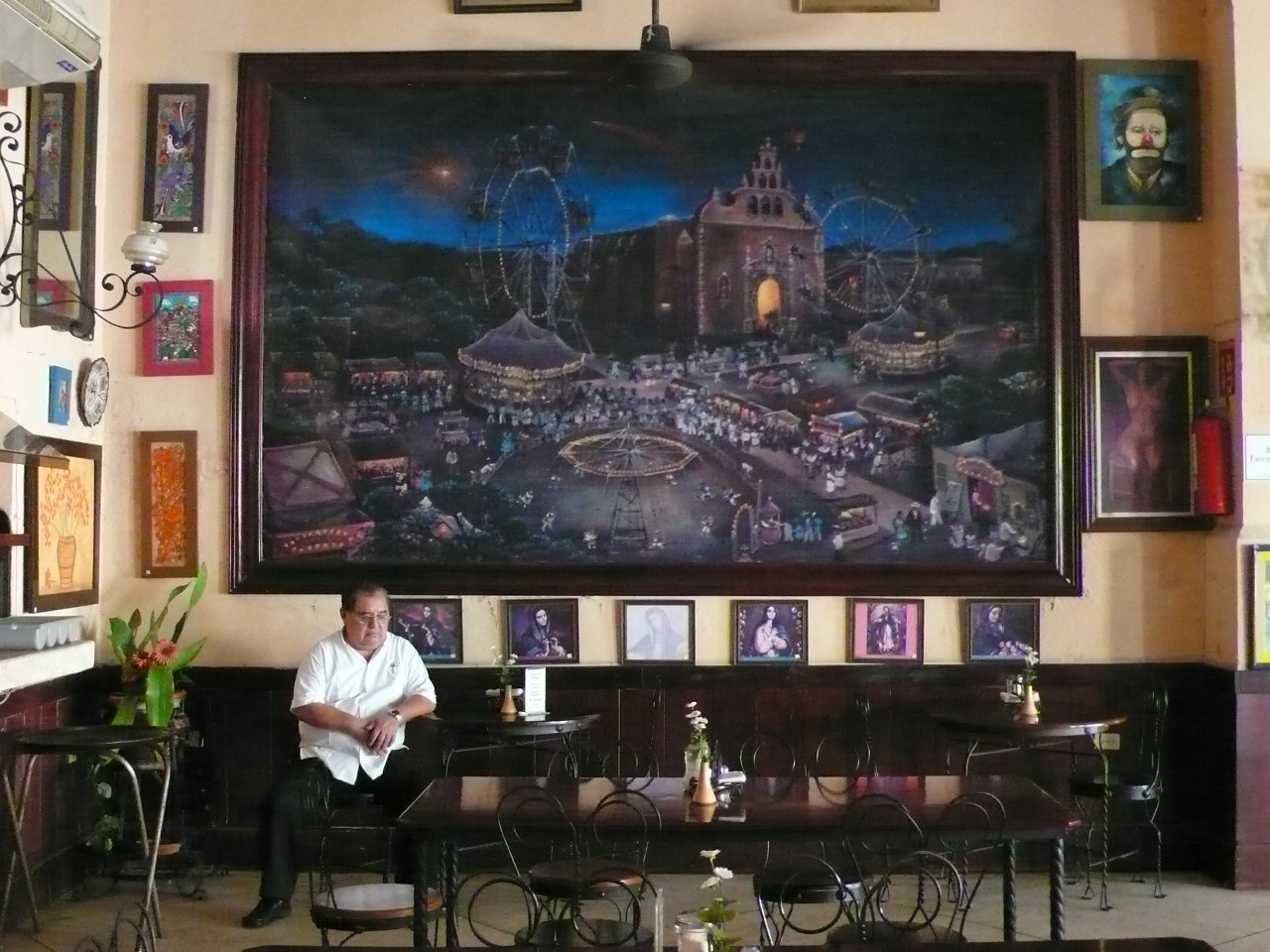
A Good Cafe on Parque Santiago


I first drank a cup of coffee in La Flor de Santiago in 2003, the same summer I bought a house three blocks down Calle 70 from this historic cafe. The Mérida barrio of Santiago was already hundreds of years old when these heavy wooden doors first swung open for business in the 1920's. Now as the oldest operating cafe and restaurant in Mérida, La Flor has earned its own place in local history.

That's only one of several reasons why I was concerned a couple of weeks ago when I walked in for a session of backgammon with my friend Diane, to be told by her that there was almost nothing available from the menu. The place was getting ready to close down, according to one of the waiters. And it certainly looked that way. The baked goods display cases were empty: bakery closed. There was no espresso coffee: machine broken and not being fixed. As we ate toast, drank our cafe americano and rolled dice, workers walked back and forth carrying loads of buckets, bottles and boxes of miscellaneous junk from a storage area to the sidewalk. There, as soon as the items were set down, scavengers and recyclers scooped the items up and hauled them off.

A mesero waits for customers on a recent slow day
It was hard not to notice that we were just about the only customers. The few others were elderly regulars who drink coffee and while away the hours talking, reading newspapers and watching traffic pass by outside the large street doors. La Flor is a big place with a lot of staff, and overhead must be high. Selling cups of coffee to customers who hang out for hours, request lots of free refills and don't eat a lot probably doesn't pay the bills. Things weren't looking all that good for La Flor.

When I first lived in my house the kitchen was not functional, so I ate out most of the time. Hot mollettes, made from french baguette baked in La Flor's own wood-fired ovens slathered with refried beans, cheese and hot salsa, and washed down with fresh-squeezed orange juice and lots of hot coffee, became a frequent breakfast of mine. Or, I'd eat choco lomo across the street in the Santiago market and afterward cross to La Flor for coffee while leisurely reading the morning's copy of Diario de Yucatán.

After I got the house fixed up and started living in Mérida full time I patronized La Flor less, but it has always been a special place. And just over the past year or so I've been spending a lot more time there again.

To be honest, the coffee in La Flor is not the best in town. But there is more to a good cafe than just coffee. La Flor is a place to meet. It's part of the neighborhood and reflects local culture. It's a place for people watching. There are old timers, many of whom arrive at the same hour daily and order the same thing they have for years. The waiters are mature, professional, friendly and remember your likes and dislikes. La Flor is a real, traditional cafe. Very few exist these days.


Most contemporary "cafes," and particularly the popular chain versions, although they may prepare a good cup of coffee, just don't compare to an established, old-style cafe. I've seen a couple of the nice old cafes in Mérida centro close over the past few years. I've tried -- and abandoned -- several of the newer ones where the staff is young, poorly-trained and managed, the music is loud and apparently played for the pleasure of the staff and not the guests, and any ambience or personality that exists seems to be more superficial marketing strategy than anything else.

I've heard since that La Flor de Santiago may remain open, but that the owners are looking for new ideas to improve the bottom line. Let's hope they manage to stay in business without changing things too much. It would be a sad loss to the community if yet another tradition fades away.


Here's Hammockman's post on La Flor.

Sunday, December 4, 2011

Living Here: Quiet Moments at the X'matkuil Fair


I always go to the Yucatán fair held each November at X'matkuil, on the outskirts of Mérida. Typically I go during off-hours, when there aren't too many people in attendance.

I drove out to the fairgrounds Friday afternoon just a little ahead of the crowds that would mob the place on this, the last weekend before closing. I like to avoid the jostle and crush. The razzle-dazzle of lights and noise, the midway, huge crowds, and the throbbing music of the beer gardens, concerts and other attractions just aren't my style.

What I like about X'matkuil is the old-time country fair aspect: prize animals, agricultural displays, crafts and the horse-riding events. I enjoy wandering and observing in the nooks and crannies of the fair, away from the the bright lights, big noise and clamor.

One of the beautiful things I saw late Friday was this pair of lovely horses. I am not a horse person, so I can't say what kind these are or describe them in accurate horsey language. One was white with gray spots, with a deep brown-red "cap" on it head that flowed like a cape down its back, and strands of reddish mane that hung down its face. The other was a soft silvery gray, with wonderful chocolate-brown freckling all over its body.

The horses were well socialized. They both noticed me and moved closer as I began to take photos. Then, at once they moved together toward the division between their separate stalls and took turns stretching their necks across the divide to nuzzle and caress each other. All the while, they maintained eye contact with me, as if posing and communicating, "See, here's my good buddy."


I enjoy watching displays of horsemanship, roping and riding, so I moved on to the arena to see what the charros, cowboys in traditional dress, were doing. I witnessed a moment of pageantry as teams of competitors entered the arena to the rhythm-heavy clamor of a four-piece band. It was great to watch the riders salute as they rode their beautiful animals around the arena. It was moving to participate moments later as the competitors and audience removed hats and applauded for one minute in memory of a fellow competitor who had recently passed away.

I visited the butterfly exhibit, a large screened-in area full of native and non-native species. It's fun to be able to walk among hundreds of free-flying butterflies, who seem to be unafraid and go about their business. In this exhibit it's possible to observe various species up close, and also to watch butterflies hatch before ones' eyes. If you stand still, it's not unusual here to have a butterfly land on you. One perched on my forehead for a moment (leaving no time to get a picture, unfortunately) before fluttering on its way.

It is interesting to see so many exotic butterflies close up, and great fun to watch the children react to the situation. Many school groups were in attendance this day, and the younger crowd is particularly enchanted by the sight of so many of these colorful insects up close. They were equally fascinated by the fish in an artificial pond inside the butterfly area.


Then there were the pigs. What can I say? I like them, especially the native Yucatecan cerdo pelon, or hairless pig. They are small, dark and bald, and I enjoyed watching a group of them rapidly vacuum up a large container of leftover tortillas in about half a minute. This is a species utilized by the Maya and that was once ubiquitous on the penninsula, but whose numbers had fallen drastically over the years as many pork producers shifted to larger, faster-growing commercial breeds. However recent efforts to revive pure genetic lines of this native animal, which is perfectly adapted to the climate and forage available in Yucatán (reducing the need for small producers to buy expensive commercial feed), seem to be successful. The population is growing, and efforts to market products from these animals as specialty items appear to be paying off.

Those are a few highlights of my afternoon at the fair. I did get into the crowds some and enjoyed a bit of the music and high-energy activity, but these quiet moments were the ones I appreciated most. X'matkuil offers something for everyone, and tens of thousands of people attend the fair and find much to enjoy. I am completely content to forego many of the big attractions in favor of exploring the smaller exhibits and quiet corners of the fair.

Here's an earlier post about the fair at X'matkuil, Yucatán in the Snow Zone.


Tuesday, November 29, 2011

Kindness For Strangers -- Pass It On

Fort Lauderdale, Florida -- A Mérida friend recently benefited from an act of kindness on the part of a complete stranger. This got me thinking about the value of kindness and other unselfish traits as we celebrated American Thanksgiving last week.

When we celebrate Thanksgiving a lot of what we are thankful for, beyond perhaps good health and the presence of loved ones, comes to us because of the unselfish actions of others. Most of these are people whom we do not know or who passed away long before our time.

I'll backtrack for a moment. When we consider the damaged economy and environment, the numerous conflicts and most of the other negative stuff that is going on around the world, it is evident that these problems exist to a great degree due to the selfish actions of a certain percentage of people. This blot stains societies, business, organizations and governments.

It all comes down to individual responsibility. Most of the good that we have is the legacy of people who have thought of the whole rather than always "looking out for number one." If the vast majority of individuals always practiced kindness, thoughtfulness, compassion and consideration in their dealings with others, many of our problems would diminish as quickly a cloud of dust whipped up by a brief windstorm.


I've thought about many kind acts I benefited from last week as I prepared for a Thanksgiving trip to see my parents in Florida, including:

My neighbor Ingrid asked about my parents' frail health. Ingrid also gave me a rosary, which had been blessed in her church, to carry on my trip. She said that even though I am not Catholic and may not share her beliefs, it would be a source of comfort and a reminder that she is thinking about and praying for us. Ingrid and her late husband Alejandro were among my first friends in my Mérida neighborhood, and used to bring me plates of food when my house didn't have a working kitchen.

Victor, the most unselfish person I know, ran my errands and brought me take-out food when I got overwhelmed with "to-dos" as I prepared to leave town.

Tony took me out to breakfast and wished me well the day before my departure.

Doña Tere, owner of the cocina economica where I often eat told me with a smile, "Don't worry, pay me next time," when I realized, after eating, that I had walked out of the house without a peso in my pocket.

Margarita woke up and drove me in the early-morning darkness to the bus terminal to catch my ride to the Cancún airport.

This is the sort of kind and thoughtful behavior that enriches the texture of my everyday life in Mérida. A part of the regular interaction between friends and neighbors who appreciate and help each other, it is something I am thankful for. However the act of kindness I mentioned at the beginning of this post, the one that my friend Debbie wrote about recently was more significant, and I think more important, because in that case someone took time to help out a complete stranger.

Most of us can learn a lesson from the anonymous man who helped Debbie. The challenge is to enlarge our circle: to treat people we do not know with the same consideration, compassion, thoughtfulness and kindness we habitually reserve for family and friends. I think that receiving this expression of respect and love from strangers prompts people to return the favor. It builds upon itself.

At the very least, these acts make us, and hopefully someone else, feel good. The truth is that in helping others, we also help and fulfill ourselves. In a world where many things are not well and the problems make us feel ineffectual, this is something positive and concrete that we actually can do every single day. Like the beads on Ingrid's rosary, one following the other in an unending loop, the acts of human kindness passed on from stranger to stranger will make a difference.

Powered By Blogger